Article

What is the Difference between ERP & CRM Software?

ERP - All industries

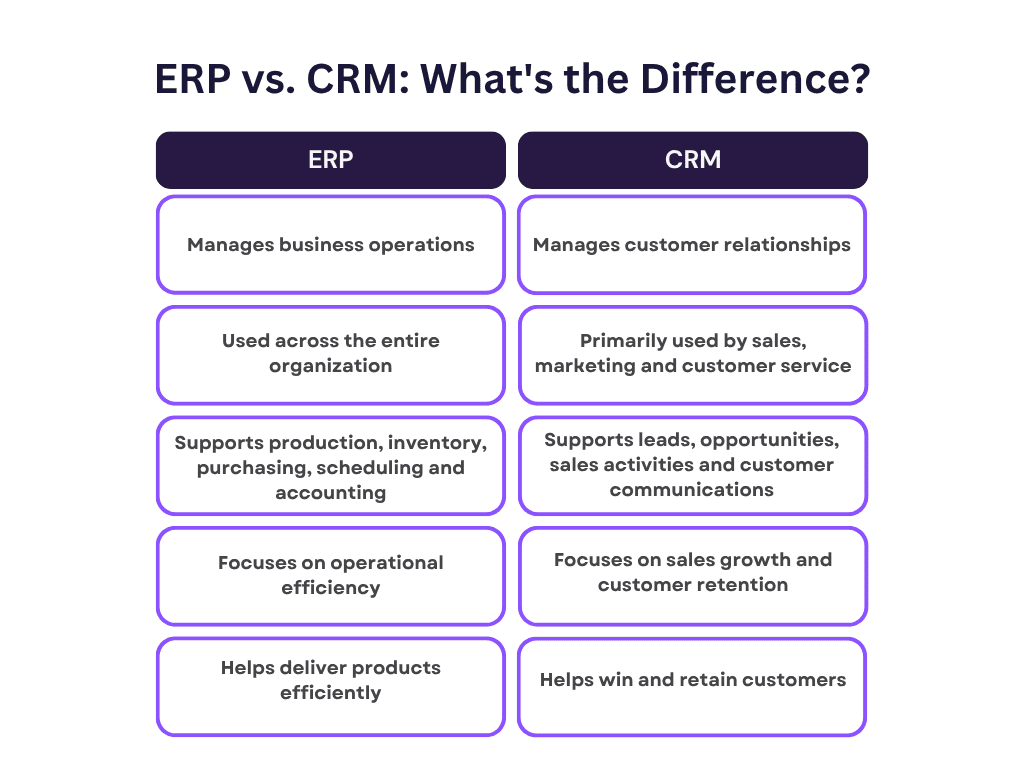
ERP vs. CRM what's the difference

ERP vs. CRM: What’s the Difference and Which Does Your Business Need?

ERP and CRM systems manage different parts of your business, but the distinction between them is not always clear. Both store important information, connect teams and help businesses work more efficiently, but they solve very different problems.

A Customer Relationship Management (CRM) system helps you manage customers, sales opportunities and relationships. An Enterprise Resource Planning (ERP) system helps you manage processes across your organization, including production, inventory, purchasing, scheduling and accounting.

For manufacturers, the question isn’t always whether you need ERP or CRM. It’s understanding which challenges each system solves and how they can work together to connect sales with the rest of your operations.

In this article:

Choosing between ERP and CRM doesn’t have to be confusing. This article explains the differences between the two systems, how they work together and why many manufacturers benefit from an ERP with integrated CRM functionality.

What is a CRM?

A CRM (Customer Relationship Management) system helps businesses manage every stage of the customer relationship, from the first sales inquiry through ongoing customer support. 

It gives your sales team one place to track leads, opportunities, customer communications and sales activities, making it easier to stay organized and build stronger relationships with both prospective and existing customers.

Manufacturing sales cycles are also often longer and more complex than those in other industries. Sales teams may be managing numerous active opportunities, multiple decision-makers, engineering discussions and quotation revisions at the same time. A CRM organizes these interactions, helping opportunities continue moving forward and ensuring no customer falls through the cracks.

A CRM can help manufacturers:

  • Manage customer and prospect information
  • Track leads and sales opportunities
  • Organize sales activities and follow-ups
  • Maintain complete customer communication histories
  • Manage the sales pipeline
  • Improve customer service and responsiveness
  • Generate reports on sales performance and opportunities

By giving your sales team better visibility into every customer interaction, a CRM helps improve communication, shorten sales cycles and increase the likelihood of winning new business.

Genius CRM

What is an ERP?

While a CRM focuses on customer relationships, an ERP (Enterprise Resource Planning) system manages the operational side of your business.

As manufacturing businesses grow, managing production with disconnected spreadsheets, accounting software and manual processes becomes increasingly difficult. An ERP brings production, inventory, purchasing, engineering, accounting, scheduling and project management together in one system. By allowing departments to work from the same real-time information, it reduces duplicate data entry, improves collaboration and gives management better visibility across the business.

For manufacturers, an ERP helps:

  • Plan and schedule production
  • Manage inventory and purchasing
  • Track costs and profitability
  • Improve production efficiency
  • Streamline accounting and financial management
  • Standardize business processes
  • Improve reporting and decision-making

Because everyone works from the same information, teams spend less time searching for data or correcting errors and more time focusing on productive work.

erp vs crm

In simple terms:

  • CRM helps you win the work.
  • ERP helps you deliver the work.

Together, they connect sales with the rest of your operations.

Do Manufacturers Need ERP, CRM or Both?

For most manufacturers, the answer is both. A CRM helps you manage the sales side of your business, including customer relationships, leads and opportunities, while an ERP connects processes across production, inventory, purchasing, scheduling, accounting and other departments.

Each system improves efficiency in a different part of the business. A CRM helps your sales team stay organized, respond to customers and win more work. An ERP helps you control costs, use resources efficiently and deliver that work profitably.

Together, ERP and CRM give manufacturers the tools to strengthen customer relationships while improving the internal processes needed to produce and deliver orders. When the two are integrated, sales and operational information can flow through the entire business, helping teams work more efficiently and make better-informed decisions.

ERP vs. CRM at a Glance

  • Use a CRM to: Manage leads, opportunities and customer relationships.
  • Use an ERP to: Manage production, inventory, purchasing, scheduling and financials.
  • Use both together: Connect sales and operations so information flows seamlessly from the first customer inquiry through production, delivery and ongoing support.

CRM Features Manufacturers Should Look For

Not every CRM is designed with manufacturers in mind. When evaluating solutions, look for features that support both your sales process and your manufacturing operations.

Contact Management

Maintain complete records for customers, prospects and key contacts, including communication history, quotations and order information.

Lead and Opportunity Management

Track potential business from initial inquiry through quotation and order, helping your sales team prioritize opportunities and follow up at the right time.

Sales Pipeline Management

Visualize where every opportunity sits within the sales process so your team can better forecast future business and identify stalled opportunities.

Tasks and Activity Tracking

Assign follow-ups, schedule meetings, set reminders and ensure customer inquiries never fall through the cracks.

Reporting and Dashboards

Monitor sales performance, pipeline activity and customer trends using real-time reports that support better business decisions.

Customer Service Management

Track customer inquiries, service requests and follow-ups alongside other customer information, making it easier to respond quickly and maintain a complete history of the relationship.


Why an Integrated ERP and CRM Works Better

Many manufacturers operate separate CRM and ERP systems. While this can work, it can also create duplicate data, disconnected processes and unnecessary administrative work. An ERP with integrated CRM functionality brings customer and operational information together, giving sales, engineering, production, purchasing and accounting access to the same up-to-date information.

That means your business can:

  • Reduce duplicate data entry
  • Improve collaboration between departments
  • Reduce communication errors
  • Respond to customer questions more quickly
  • Create more accurate quotations
  • Track every stage of a customer’s order
  • Gain complete visibility into customer history and profitability

For manufacturers producing custom or engineer-to-order products, this visibility is especially valuable. Sales teams can work with engineering to develop accurate quotations, while production and purchasing teams receive the information they need without re-entering data or searching across multiple systems.

Integration also improves decision-making. Because sales, engineering, production and accounting all work from the same information, managers gain a complete view of each customer relationship — from the first sales inquiry through production, invoicing and repeat business. This visibility makes it easier to identify bottlenecks, forecast demand and deliver a more consistent customer experience.

How ERP and CRM Work Together

An integrated ERP and CRM does more than reduce duplicate data entry — it connects every stage of the customer journey. From the first sales inquiry to production, shipping and ongoing customer support, the same information is available to every department that needs it.

Without an integrated system, information often has to be re-entered as work moves from sales to engineering, production and accounting. This creates delays, increases the risk of errors and makes it more difficult to keep customers informed. An integrated ERP and CRM reduces manual data transfer by allowing information to flow more easily between departments.

Lead → Opportunity → Quote → Sales Order → Engineering → Purchasing → Production → Shipping → Invoice → Ongoing Customer Relationship

As an opportunity becomes an order, the information captured by sales supports each subsequent stage of the work. Sales records customer requirements and prepares the quotation; engineering finalizes technical details as needed; purchasing sources materials; production schedules and manufactures the work; and accounting manages invoicing.

Throughout the process, every department works from the same real-time information, reducing manual data entry, improving collaboration and giving employees complete visibility into every customer order.

How ERP Improves the Customer Experience

Your customers will probably never know what ERP software you use. What they do notice is whether your quotes are accurate, your pricing is consistent, their questions are answered quickly and their orders are delivered on time.

Although customers may never interact directly with your ERP system, they experience its results every time they do business with you. Better internal processes lead to better customer experiences, and satisfied customers are more likely to place repeat orders and recommend your business to others.

Choosing the Right Solution

Choosing between ERP and CRM isn’t really about deciding which system is better. It’s about identifying which business challenges you’re trying to solve.

If your biggest priority is improving sales performance and managing customer relationships, a CRM can help organize your sales process and improve customer engagement.

If your business needs better control over production, inventory, purchasing, scheduling and financial management, an ERP should be your priority.

For many manufacturers, the greatest value comes from an ERP with integrated CRM functionality. Connecting sales and operations reduces manual work, improves collaboration and gives teams better visibility from the initial opportunity through production and delivery.

Final Thoughts

A CRM helps you manage customer relationships, sales opportunities and new business. An ERP helps you plan production, manage operations and deliver orders efficiently.

When the two systems work together, information can flow from the first customer interaction through quotation, production, delivery and ongoing support. This connection helps manufacturers reduce manual work, improve efficiency and provide a more consistent experience for both employees and customers.

—-

Want to learn more about what a CRM can do for your manufacturing business? Explore the top 5 benefits of a CRM for manufacturers or discover Genius CRM, a fully integrated CRM built for manufacturers that sell complex products.

Get your eBook Scared to implement a new ERP?

"*" indicates required fields

This field is for validation purposes and should be left unchanged.
close-btn

Let’s talk about your shop