



This session is Genius pulling back the curtain on its AI roadmap with real specifics rather than buzzwords — and pairing it with a partner, Stellasource, that’s about two years into its own AI journey in the metals industry, for a useful outside perspective. Dom (Genius’s CTO of 25 years) and Mohamed Ben Salem (head of AI and software architecture) split what’s discussed into three buckets: automating transactional work (Smart Paste, already live in v16.2, which turns pasted email or Excel text into a structured quote or order), assisting users through a conversational agent that can eventually be trained on a customer’s own documentation, and predicting purchasing decisions better than a typical buyer by learning from historical patterns rather than following imperfect data blindly. Mohamed is refreshingly direct about data privacy (customer data is never used for training and disappears after each query) and shares real accuracy numbers where Genius’s prediction model already beats human buyers. Donnie and Ryan from Stellasource add a candid, occasionally funny outside view — including a clear warning against chasing “AI” for its own sake — plus their own parallel work on quote automation and multimodal document processing. A live poll shows attendees split roughly 50/50 on whether they’re already using AI in their business, with inventory, quoting, and purchasing named as the areas expected to benefit most.
What You’ll Learn In This Webinar
Chapter 1 — Webinar Overview and Poll
A live poll on current AI usage comes back roughly 50/50, compared to 35% using / 55% not using in that morning’s French session. The agenda is previewed: a Stellasource introduction, Genius’s AI roadmap, real use cases across automation, assistance, and prediction, and a closing Q&A.
Chapter 2 — Stellasource Company Introduction
Donnie describes Stellasource (founded from and built around the metals industry since January 2023) as focused on simplifying the sales process for metal suppliers and buyers — service centers, fabrication shops, and similar businesses — through products like Stellar eCommerce (an always-on customer portal) and Sekturipad (a quoting tool for metal service centers and fabricators).
Chapter 3 — Genius Roadmap and AI Focus
Before getting into AI, Dom covers a communication upgrade coming by year-end: full email send/receive/reply and communication history directly on any Genius document, plus an Outlook plugin to tag emails to transactions — explicitly framed as groundwork for AI-driven transaction creation. Genius’s AI project itself started a few months ago and is described as only “the tip of the iceberg” of an 18-24 month effort led by a dedicated team under Mohamed.
Chapter 4 — AI Use Cases and Automation
Smart Paste, live today in version 16.2, lets a user paste unstructured text — an email, even one embedded in casual conversation — directly into a quote or order, with the AI extracting the items, quantities, and details automatically; it also works with content copied from Excel. Planned next: an Outlook integration that can create a brand-new quote or order directly from an email, identifying the contact/customer, building the header and line-item detail, and matching attachments to the right lines — first for quotes and sales orders, later extended to purchase orders and invoices.
Chapter 5 — Semantic Search and AI Integration
Beyond exact or typo-tolerant (“fuzzy”) search, Genius is adding semantic search, which matches terms by meaning rather than spelling — Mohamed’s example: a “corrosion resistant metal sheet” would semantically match a “stainless plate,” which is useful when a customer’s own wording doesn’t match the system’s item descriptions.
“Semantic search uses the meaning of the word and queries based on the meaning.” — Mohamed Ben Salem
Chapter 6 — Stellasource’s AI Journey
Ryan recounts Stellasource’s roughly two-year AI journey, starting with internal productivity use in June 2023, then nesting optimization for customers, then quote automation (extracting items from pasted text, much like Genius’s Smart Paste), and now moving toward multimodal AI that can process text, images, and eventually CAD drawings. He stresses “continuous innovation” given how fast underlying models change (citing one model that went from version 4.7 to 5.7 in about two months) and highlights AI’s use in security/compliance monitoring — surfacing 10-15 real issues out of hundreds of thousands of log entries that would otherwise go unreviewed. His closing caution: make sure a given AI feature delivers real value, rather than adopting AI just to say you have it.
Chapter 7 — Predictive Analytics in Inventory Management
Recommended reordering is an existing Genius module (getting new screens, not a new concept) that flags items falling short of stock and lets a buyer build a purchase or production “basket” and generate POs automatically — but it only works well if inventory levels, min/max, lead times, and vendor data are kept perfectly accurate, which rarely happens in practice; buyers compensate by over- or under-ordering, creating excess WIP or late deliveries. The AI goal is to predict better lead and production times by comparing system-calculated dates, buyer adjustments, and actual outcomes — using a separate, lighter-weight prediction model (not the conversational LLM) that can run locally alongside Genius Web. Early results show Genius’s model with a notably lower mean absolute error than human buyers, clustering much closer to the ideal (actual outcome) line — human decisions were found to be comparatively erratic and reactive to recent events. Several candidate models were tested before selecting Random Forest as the base.
Chapter 8 — Feedback and Future Directions
A live poll asking which area of the business attendees expect AI to impact most puts inventory, quoting, and purchasing at the top. Dom closes with a reminder of the September 18 Genius Synapse customer event in Montreal.
Chapter 9 — Q&A Session
Donnie asks how supply/vendor availability factors into predictions — Dom notes this is being explored, potentially by ingesting vendor-side data directly to further train the model. Ryan asks about hallucination; Mohamed acknowledges it’s a real, ongoing challenge managed by carefully curating (“distilling”) the data used for retrieval and iterating through a testing feedback loop — an industry-wide issue, not unique to Genius. Ryan shares Stellasource’s own challenge getting AI to reliably produce well-formed structured output (like JSON) for direct application integration, and flags “idempotence” (consistent, repeatable responses) as a next frontier for the industry. In rapid-fire audience Q&A: AI features will work with both local and cloud installations; generating a PO by scanning a quote or document is already something both companies are actively working on; tracking something like a customer’s last shipment status via the conversational agent is a planned use case, potentially with a direct link back to the underlying transaction; the AI agent and LLM functionality will be exposed through Genius’s public API with no technical constraint; a metal-distribution-specific question about importing vendor material/build schedules and stock levels is confirmed as a natural extension of the same Smart Paste-style import already used for quotes; and the new communication tool will be available across the CRM as a whole, not just for AI-specific use cases.
FAQ
Will customer data be used to train Genius's AI models?
No — customer data is only injected into the query context at runtime and is discarded immediately afterward. It’s never used for training and never leaves the customer’s own environment unless they choose otherwise.
Does Genius's AI already work today, or is it all future roadmap?
A mix — Smart Paste is live today (version 16.2), while the conversational agent, deeper Outlook automation, semantic search, and predictive reordering are rolling out over the next 18-24 months.
How does Genius handle AI hallucination?
By carefully curating and “distilling” the data used for retrieval-augmented generation, and iterating through a testing and feedback loop — acknowledged as an industry-wide challenge, not unique to Genius.
Will these AI features work with both cloud and on-premise installations?
Yes, confirmed — the services run in the cloud but link to both platforms without issue.
Will the AI agent be accessible through Genius's public API?
Yes, confirmed with no technical constraint, for customers who want to integrate it into their own tools or workflows.

Get your eBook Scared to implement a new ERP?
"*" indicates required fields
Explore related articles

How will Artificial Intelligence Impact ERP Software?
AI technology built directly into ERP systems can help automate routine processes or create better user experiences by learning and adapting to user's language, allowing systems to better understand and respond to users.
What’s New in the HubSpot–Genius ERP Integration
See how our integration with HubSpot connects customer information, quotes and sales orders across both systems.
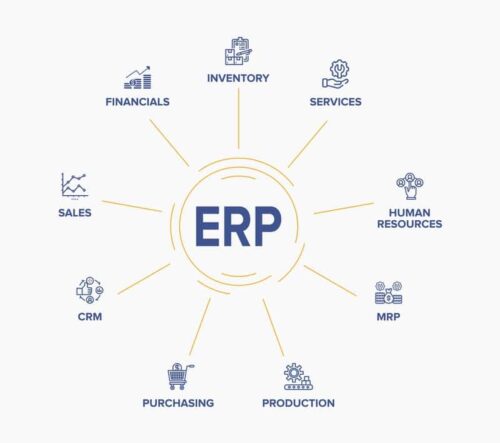
Back To Basics: What Is an ERP?
An ERP is business process management software that connects and integrates every aspect of a business — giving manufacturers visibility over their entire operation and allowing them to create better manufacturing processes, lower costs, and improve performance.

A manufacturing ERP that works as hard
as you do.
Give us a call to see how we’re different.

