We compare ERP systems by manufacturing type to help you narrow down your options. We’ll also cover what to look for in an ERP partner, from industry expertise and training to implementation and long-term costs.
The best ERP for manufacturing in 2026 depends on what you make, how you make it and what your business needs. A manufacturer building custom machinery has different requirements from one producing the same products in large volumes. Your ERP should support the way you work and connect quoting, engineering, purchasing, production and accounting.
At Genius ERP, we work only with manufacturers, so we know what it takes to get it right. Choosing the best software is about finding the best fit for you. Your team has to work with this software every day. You need a system they can use confidently and a partner who understands how your shop runs.
Manufacturers have a range of ERP systems to choose from, including Genius ERP, Epicor Kinetic, Infor CloudSuite Industrial, SAP S/4HANA and ProShop ERP. Which systems belong on your shortlist depends on your manufacturing type, the features you need and the resources you have for implementation and ongoing support.
Best Manufacturing ERP Systems at a Glance
Manufacturing ERP systems support different ways of working, from engineering custom equipment to assembling standard products or running a busy job shop. Below, we compare some of the top manufacturing ERP options, highlighting their manufacturing fit and key strengths to help you decide which systems deserve a closer look.
| ERP system | Manufacturing fit | Key strengths |
|---|---|---|
| Genius ERP | Custom manufacturing: ETO, MTO, CTO, ATO and job shops | CAD2BOM, product configuration, job costing and constraint-based scheduling |
| Epicor Kinetic | Discrete, mixed-mode and repetitive manufacturing, including job shops | Production management, configuration, scheduling and quality tools |
| Infor CloudSuite Industrial (SyteLine) | Discrete and mixed-mode production: ETO, CTO, MTO, MTS and repetitive | Production planning, inventory, supply chain and quality management |
| Acumatica Manufacturing Edition | Discrete manufacturing, job shops and mixed-mode operations; process manufacturing | BOMs, estimating, production management and a rules-based product configurator |
| Global Shop Solutions | Job shops, custom fabrication, ETO, MTO, MTS and mixed-mode production | Quoting, scheduling, shop-floor control, CAD integration and accounting |
| Total ETO | ETO and project-based work: machine builders, integrators, panel shops and OEMs | CAD integration, staged BOM releases, project costing and purchasing |
| ProShop ERP | Precision job shops, especially aerospace, defense and medical manufacturing | Integrated ERP/MES/QMS, digital work instructions and inspection tracking |
| JobBOSS² | Small and mid-sized job shops and make-to-order manufacturers | Estimating, job costing, scheduling and inventory control |
| SAP S/4HANA | Complex discrete, repetitive and process manufacturing | Production planning, capacity management, materials planning and quality management |
| NetSuite | Discrete manufacturing, including MTO, MTS and assembly operations | Financial management, inventory control, production planning and reporting |
| Katana | MTO and MTS product manufacturers, including e-commerce and multichannel businesses | Inventory visibility, production tracking and e-commerce integrations |
| Plex ERP | Discrete and process manufacturing, especially automotive and food and beverage | Integrated ERP/MES, production visibility, quality management and traceability |
| BatchMaster ERP | Process and batch manufacturing: food, chemicals and pharmaceuticals | Formulation, batch production, quality control and lot traceability |
Best ERP Software by Manufacturing Type
Each production model comes with different requirements. The sections below explain what to look for and where each ERP stands out, helping you move from a broad list of options to a shortlist that fits your shop.
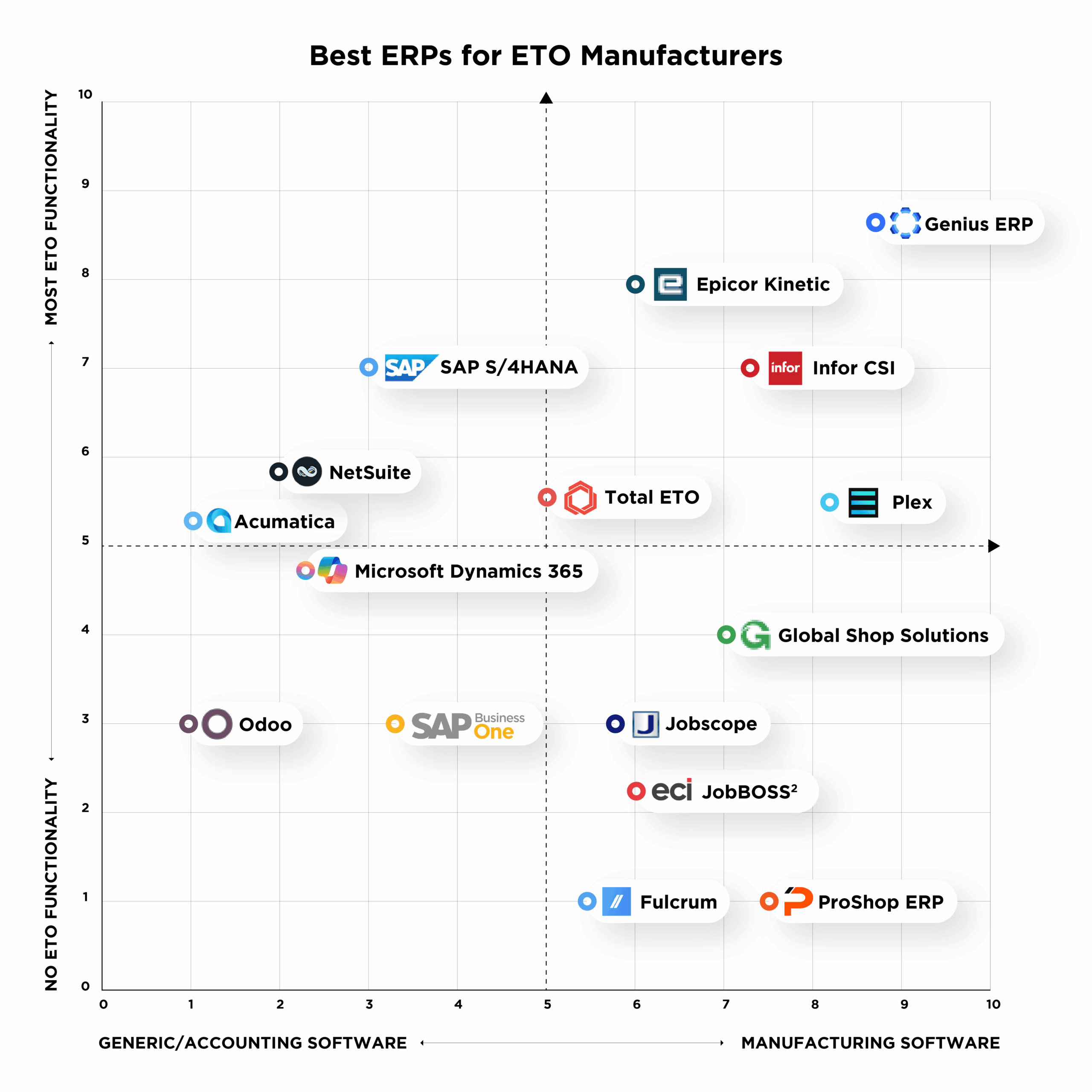
Best ERPs for Engineer-to-Order Manufacturers
Engineer-to-order (ETO) manufacturers design or adapt products to meet a customer’s requirements. Quoting and purchasing often begin while engineering is still underway. A design change can affect the parts you buy, the work already scheduled and the final cost of the job.
The best ERP for ETO manufacturing should connect engineering, purchasing and production. Look for CAD integration, BOM revision control and job costing, along with the ability to release work as designs develop.
- Genius ERP – Built for custom manufacturers, Genius ERP is a strong fit for ETO businesses that need to keep engineering and production connected. CAD2BOM transfers design information from SOLIDWORKS and Inventor into Genius, while revision tools help teams identify changes and update affected jobs. Preliminary purchasing and production support work that needs to start before the full design is complete. Combined with job costing and constraint-based scheduling, these tools help equipment builders manage changing requirements and keep a close eye on project margins.
- Global Shop Solutions – A solid choice for shops combining ETO, make-to-order and repeat work. Its CAD interface and BOM Compare tools support engineering, while quoting, scheduling, shop-floor control and accounting cover the wider operation. Its appeal is the all-in-one approach, particularly for manufacturers that want engineering information connected with day-to-day shop management.
- Epicor Kinetic – A broad manufacturing ERP with engineering, job management and configuration capabilities. For ETO, we see it as a stronger fit for larger organizations that need to manage engineered products alongside other manufacturing workflows. Its flexibility gives those businesses room to grow, but getting the right setup takes implementation resources and ongoing attention.
- Infor CloudSuite Industrial (SyteLine) – A strong option for manufacturers balancing engineered orders with more standardized production. Planning, materials management, project capabilities and quality tools support a range of manufacturing needs. Its flexibility suits mixed-mode manufacturing, but smaller shops may find the setup and ongoing management demanding.
- Acumatica – A flexible cloud ERP that can appeal to growing companies. It connects estimating, BOMs, production orders and costing, with project accounting available for project-driven work. Acumatica can work well for ETO manufacturers, but it isn’t ETO-specific. Manufacturers with extensive engineering requirements should look closely at how CAD integration, design changes and project workflows will be handled. Its consumption-based pricing can also appeal to companies expanding access across their teams.
- Total ETO – A focused choice for custom machine builders, systems integrators, panel shops and OEMs. CAD integration, staged BOM releases and project costing address the realities of work that develops throughout engineering and production. Its separate accounting integrations are a meaningful difference: it can suit manufacturers that want to keep their financial software while improving how they manage ETO projects.
Best ERPs for Configure-to-Order Manufacturers
Configure-to-order (CTO) manufacturers build products from predefined options. Customers may choose different sizes, components or features, but those choices need to work together. Quoting mistakes or incorrect configurations can lead to rework, delays, and unhappy customers.
The best ERP for CTO manufacturing connects product configuration with quoting, BOMs and production. Your sales team should be able to quote valid combinations, with the right costs and manufacturing requirements following the order through the shop.
- Genius ERP – A strong fit for custom manufacturers balancing CTO and ETO work. Its Product Configurator uses predefined options and rules to create quotes, BOMs and routings, reducing repeated engineering work for established configurations. When an order needs further design, Genius’s engineering and production tools support that work in the same system. This makes it particularly useful for high-mix shops whose products don’t all follow one production model.
- Epicor Kinetic – Known for its product configurator, Epicor handles complex rules and dependencies well, automatically creating BOMs, routings, and costs. It’s a strong fit for manufacturers with highly customizable products, though the configuration rules need careful setup and maintenance. Some features, such as visual configuration or tools for dealers and online sales, may require additional software.
- Infor CloudSuite Industrial (SyteLine) – With advanced quoting and configuration features, Infor CSI works well for manufacturers running both CTO and MTO operations at scale. Integrated supply chain and planning tools support multi-site companies, giving mature organizations better visibility and control. Smaller shops may find the system takes significant time and resources to set up and manage.
- Acumatica Manufacturing Edition – A flexible option for growing manufacturers that need configuration alongside broader business management. Its own rules-based Product Configurator creates BOMs and routings with calculated costs and prices, supporting quotes, sales orders and production orders. It deserves consideration for businesses combining configured products with other manufacturing workflows.
- Global Shop Solutions – A practical choice for manufacturers that want configuration connected with the rest of their shop operations. Its Product Configurator builds BOMs, routings and prices from selected options and connects with sales and inventory. The wider ERP brings quoting, purchasing, shop-floor activity and accounting together, giving it appeal beyond the configurator itself.
- Plex ERP – A cloud-native ERP with strong shop-floor integration, quality management and traceability. Its connected ERP and manufacturing execution tools help teams follow configured orders through production, track component use and maintain inspection records. It’s a good fit for CTO manufacturers in regulated industries, particularly automotive suppliers, where customer-specific products need consistent production processes and detailed quality records.
Best ERPs for Assemble-to-Order Manufacturers
Assemble-to-order (ATO) manufacturers stock components or subassemblies, then assemble finished products when customer orders arrive. The challenge is keeping the right parts available without tying up too much cash in inventory.
The best ERP for ATO manufacturing connects inventory, purchasing and assembly schedules with customer demand. Your team needs to know what is available, what is already committed and what could hold up an order.
- Epicor Kinetic – Advanced configuration and inventory management tools make Epicor a strong choice for complex ATO operations. It can automatically generate BOMs and routings based on order-driven assemblies, streamlining the process. Implementation is often resource-heavy, but for companies scaling up, the configurator depth can deliver real value.
- Genius ERP – Well-suited to manufacturers that assemble products from stocked subassemblies while also handling custom, engineered or configured work. Genius connects inventory, purchasing, production planning and job costs so teams can coordinate parts and assembly requirements. Its Product Configurator also supports products built from predefined options. It’s a practical fit for shops that need repeatable assembly processes alongside the flexibility to handle customer-specific requirements.
- Infor CloudSuite Industrial (SyteLine) – Infor CSI brings deep planning and scheduling capabilities that help ATO manufacturers manage component availability and delivery timelines. Integrated supply chain and production modules support multi-site operations and fast turnaround. It’s a system that tends to fit larger organizations with the resources to handle its complexity, though it can work for small- to mid-sized operations as well.
- Acumatica – Cloud-first and flexible, Acumatica supports ATO workflows with solid inventory, BOM, and costing features. Its licensing model can be attractive for growing manufacturers who want scalability without steep per-user costs. Its Product Configurator supports products assembled from predefined options, making it worth considering for businesses combining assembly with configured orders and other production workflows.
- Plex ERP – With strong real-time shop-floor data and traceability, Plex is a good match for ATO manufacturers in regulated industries like aerospace, electronics, or automotive. The cloud-native platform supports digital manufacturing and compliance needs, with particular value when component records, inspections and production reporting need to stay connected.
- SAP Business One (SAP B1) – Though not always top-of-mind for ATO, SAP B1 can work well for small to mid-sized companies. Integrated modules for inventory, purchasing, planning, and sales help keep subassemblies on hand and final assemblies moving. It’s not as specialized as some ERPs but offers a solid, all-around option.
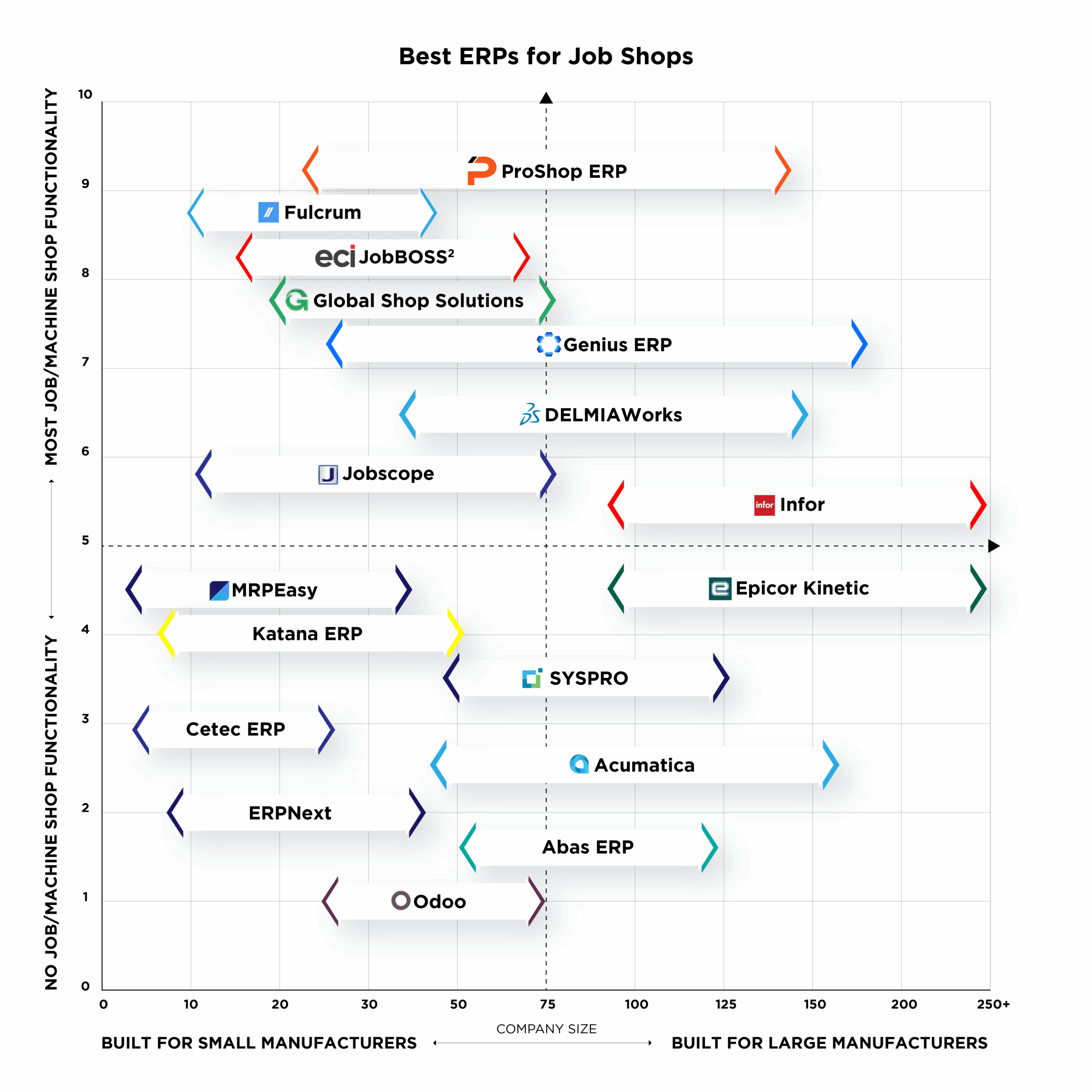
Best ERPs for Make-to-Order Manufacturers and Job Shops
Make-to-order (MTO) manufacturers begin production after receiving a customer order. Their ERP needs to connect each order with its materials, production schedule and costs so they can set realistic delivery dates and protect margins.
Job shops often operate this way, with the added challenge of different jobs following different routings and competing for the same machines and people. Accurate estimating, flexible scheduling and actual job costs become especially important when the mix of work changes every day.
The best ERP for MTO manufacturers and job shops connects the original quote with purchasing, shop-floor activity and the final job cost.
- ProShop ERP – A strong choice for precision job shops, especially in aerospace, defense and medical manufacturing. Its connected ERP, MES and QMS bring production activity, work instructions and inspection records into a paperless workflow. Quality and documentation are central to its appeal. That approach works best when the team is ready to maintain detailed records as part of everyday shop-floor work.
- JobBOSS² (ECI Software) – A longtime player in the job shop space, JobBOSS² offers quoting, job tracking, and scheduling in a familiar format many shops already know. Its focus on job and machine shops makes it a natural shortlist candidate for businesses organizing their day-to-day work around individual orders. The package and additional applications matter when quality, reporting or integration requirements extend beyond those core needs.
- Fulcrum – A cloud manufacturing platform with a strong focus on live production information. Quoting, inventory, purchasing, job tracking, automated scheduling and quality tools support shops that want costs and progress updated as work happens. Its approach will appeal to teams ready to replace manual updates with more consistent digital reporting across the shop.
- Genius ERP – A strong fit for MTO manufacturers and job shops that need quoting, engineering, purchasing and production to work together. Genius connects estimates, BOMs, scheduling, shop-floor reporting and job costing so teams can follow a job from bid to delivery. Smart Scheduling helps plan around production constraints, while CAD2BOM and the Product Configurator support shops that also take on engineered or configured work. This makes Genius particularly useful when custom manufacturing involves more than tracking individual jobs.
- Jobscope ERP – A good fit for order-driven manufacturers whose jobs involve substantial engineering or project coordination. It combines engineering, materials management, production and financial tools, making it worth considering when individual orders need broader oversight than basic job tracking. Its project focus is especially relevant for equipment builders and other manufacturers managing work over longer project cycles.
Best ERPs for Make-to-Stock Manufacturers
Make-to-stock (MTS) manufacturers produce goods in advance using forecasts and inventory targets. Too much stock ties up cash, while too little can mean missed sales.
The best ERP for MTS manufacturing connects demand planning, production and inventory so teams can adjust purchasing and output as demand changes.
- SAP S/4HANA – Best suited to large enterprises, SAP S/4HANA brings deep supply chain orchestration and production planning together on one platform. It handles real-time inventory across global operations and integrates procurement, warehousing, and manufacturing. Advanced forecasting and analytics make it ideal for high-volume MTS organizations, though its cost and complexity put it out of reach for most smaller manufacturers.
- Epicor Kinetic – A strong fit for mid-sized MTS manufacturers, Epicor combines production planning, scheduling, and inventory management in one system. It supports batch production and demand-driven replenishment, helping companies balance efficiency with responsiveness. The system scales well, but implementation and upkeep can require significant resources.
- NetSuite – As a cloud-first ERP, NetSuite unifies financials, order management, and inventory control. It gives clear visibility into stock levels, safety stock, and reorder points, making it practical for manufacturers wanting tighter back-office and production alignment. Manufacturing tools aren’t as deep as specialized ERPs, but the modern cloud platform appeals to growing companies.
- Katana – Designed for small manufacturers, Katana provides real-time inventory tracking, multilevel BOMs, and simple production planning in an easy-to-use interface. E-commerce and accounting integrations make it a good fit for MTS companies selling direct-to-consumer. It doesn’t offer the depth of bigger systems, but it’s a cost-effective first step toward ERP.
- Odoo – A flexible option for manufacturers that want to build their system around a selection of connected apps. Manufacturing, inventory, purchasing and sales can sit alongside quality, maintenance and PLM. Its modular approach is appealing, but choosing the right applications and implementation support is an important part of making that flexibility work for your business.
Best ERPs for Repetitive Manufacturers
Repetitive manufacturers produce standardized products or parts in recurring runs. Material shortages, downtime and small production delays can affect a large amount of output.
The best ERP for repetitive manufacturing supports materials planning, capacity and production flow while giving teams useful information about output, scrap and quality.
- SAP S/4HANA – A top choice for enterprise manufacturers, SAP S/4HANA handles complex flow production with supply chain, execution, and quality all tied together. Advanced planning tools and real-time analytics help optimize operations across multiple plants. It’s best suited to larger manufacturers with the resources to handle implementation and ongoing support.
- Infor LN – Best considered for larger manufacturers with complex discrete production and supply chains. Its scope includes assembly-line, configured and project-based work, making it relevant to automotive suppliers and equipment builders combining several production models. Its appeal extends beyond high-volume production to coordinating engineering, supply and manufacturing across the business.
- Epicor Kinetic – A good mid-market choice for manufacturers blending repetitive work with other discrete production. Planning, scheduling, lean manufacturing tools and shop-floor data collection support that mix. Its flexibility is useful for companies that need to manage recurring production without treating every part of the shop the same way.
- Plex ERP – A strong candidate for production-intensive manufacturers, particularly automotive suppliers. Integrated ERP and manufacturing execution connect production visibility, quality and traceability with business operations. Its shop-floor focus is a clear point of difference for manufacturers that need to monitor production closely, with planning tools available to coordinate supply and demand.
- DELMIAWorks, formerly IQMS – A strong option for manufacturers in sectors such as plastics, where production monitoring and business planning need to stay closely connected. Its combined ERP and MES cover scheduling, quality, traceability and production activity. It deserves particular attention from small and mid-sized manufacturers whose requirements align with those production environments.
Best ERPs for Process Manufacturers
Process manufacturers work with formulas or recipes, with requirements that vary by product and industry. Ingredient quantities, batch consistency, traceability and quality records all affect what can be produced and shipped.
The best ERP for process manufacturing connects formulation, production, inventory and quality. For continuous operations, manufacturers should also assess material flows, yield tracking and connections with process-control systems.
- BatchMaster ERP – Strong in recipe-driven production, BatchMaster covers formulation, batch processing, compliance, and traceability in depth. It’s widely used in chemicals, nutraceuticals, and food and beverage, where process controls are critical. Not built for discrete work, but for fully process-driven companies it’s one of the most capable ERPs available.
- Aptean Process Manufacturing ERP – Worth considering for manufacturers seeking an industry-focused process solution. Aptean offers distinct products, including Ross and ProcessPro editions, so the specific product matters. Formula management, batch production, quality and traceability should be assessed against your industry’s requirements rather than treating the Aptean portfolio as one system.
- Deacom ERP – Designed for mid-market process manufacturers, Deacom unifies formula management, quality, compliance, and production in a single system. The “all-in-one” model reduces reliance on bolt-ons, keeping operations under one platform. It works best for companies willing to adapt to Deacom’s standardized workflows rather than customize heavily.
- Infor M3 – Infor’s M3 platform targets process manufacturers at an enterprise scale, particularly in chemicals, food, and beverage. It brings strong global supply chain, production planning, and compliance capabilities, backed by advanced analytics. Powerful and scalable, though resource-intensive to implement, making it most suitable for larger organizations.
- Aptean Food & Beverage ERP, JustFood Edition – A focused option for food and beverage manufacturers that need recipe management, food safety, quality and recall traceability connected with everyday operations. Its food-specific capabilities are the main reason to shortlist it. For manufacturers in that sector, the specialization can be more useful than a broader ERP that needs additional work to support those requirements.
How to Choose the Right ERP Partner in 2026
Picking the best manufacturing ERP isn’t just about features on paper—it’s about finding a partner that knows your industry.
Importance of Industry Expertise, Training, and Support
A system that looks good in a demo can quickly become a headache if your ERP vendor doesn’t understand how manufacturers really work. Here are some questions to ask before making your decision:
- Does this ERP specialize in manufacturing? Ask the vendor to show how the system handles work like yours, from engineering changes and purchasing to scheduling and job costing. A system built around your manufacturing processes can reduce the need for workarounds and make it easier for your team to adopt. Your implementation partner should understand those processes, too.
- What does implementation look like? ERP success comes down to training, adoption, and support. Ask about timelines, responsibilities and how the vendor defines a successful implementation. Who will handle data migration and configuration? How much time will your employees need to commit? What training will each team receive? Ask to speak with customers whose operations are similar to yours.
- Will the ERP scale with you? You don’t want to outgrow your ERP in a few years. Look for platforms that can support your current needs while handling future growth. That could mean more orders, more employees, another location or a wider range of products. Be specific about the growth you expect, and ask what changes it would require in the software.
- What will the system cost over time? Compare more than the initial software price. Ask for a clear breakdown of implementation, data migration, training, required modules, integrations and ongoing support. Find out how pricing changes as your business grows and what future upgrades or customizations could involve.
- Who supports you after go-live? Ask who your team will contact when something goes wrong, what support is included and how additional training is handled. A successful launch matters, but so does having a partner who can help you keep improving how you use the system.
ERP Price Guide: How Much Does a Manufacturing ERP System Cost?
What to Look for in a Manufacturing ERP in 2026
When comparing ERPs in 2026, look at where each vendor is investing as well as what the software can do today. Are they improving the manufacturing tools your team relies on? Are new features solving problems you actually have?
Emerging Trends: AI, IoT, and Real-Time Data
Ask vendors how AI, machine connectivity and real-time production data will help your team get work done.
Look for:
- AI tools for smarter scheduling, quoting, and document automation.
- IoT connectivity to track machines, tools, and shop-floor performance in real time.
- Live dashboards that give managers visibility across production, inventory, and supply chain.
Ask vendors to demonstrate these tools using a task that matters to your business, such as processing an incoming order, updating a quote or identifying a production delay. Find out what information the system needs, what your team still has to review and whether additional applications or equipment connections are required.
Also be clear about what is available now and what is still on the roadmap. A planned feature may be worth following, but you need to know whether the system you are buying can handle the work you need it to do today.
For the longer term, look for a vendor whose plans align with your business. Continued investment in manufacturing matters more than a long list of new features that your shop will never use.
Challenges Manufacturers are Facing in 2026
Manufacturers need to keep production moving while dealing with:
- Supply chain complexity: Uncertain supplier lead times, shipping delays and changing material costs.
- Labor shortages: Hiring challenges are pushing manufacturers to maximize output with the teams they have.
- Pressure on margins: Customers expect faster delivery and higher quality, but not higher prices.
Use these challenges to guide your ERP evaluation. Ask how the system helps your team respond when a supplier is late, a machine is unavailable or a job starts running over budget. Can you see the affected orders, adjust the plan and understand the cost?
Those are the kinds of everyday decisions your ERP should help you make. The best system for your shop is one that gives your team the information and tools to respond, while continuing to improve the software as your business grows.
How Genius ERP Supports Custom Manufacturing
Genius ERP focuses on manufacturers whose work changes from one order to the next. Whether you’re engineering custom equipment, configuring products or managing a busy job shop, it connects quoting, engineering, purchasing, production and accounting so your team can work from the same information.
Related Reading: ERP Solutions for Manufacturers
Real-Time Shop Floor Tracking
Genius ERP connects your office and shop floor in real time:
- Track job progress, labor time and material use as work happens.
- Give operators access to current work orders, drawings, instructions and quality checks.
- Use barcode scanning to update tasks and record shop-floor activity without relying on paper updates.
Other key features include:
- CAD2BOM Integration: Turn SOLIDWORKS and Inventor models into BOMs for purchasing and production. Release long-lead items early while engineering finishes the design.
- Product Configuration: Create quotes, BOMs and routings from predefined options and rules, reducing repeated engineering work for configured products.
- Smart Scheduling: Build schedules around your shop’s production constraints and test changes before updating the live schedule.
- Quoting & Costing: Build estimates using material, labor and overhead costs, then compare estimates with actual job costs to understand margins and improve future quotes.
- AI and Automation: Reduce manual entry with tools such as Smart Paste and Genius IDP, and use workflows to manage approvals, notifications and status updates.
Customer Success Stories & Case Studies
The real test of an ERP isn’t a feature list—it’s what manufacturers achieve with it. Here are a few stories from shops using Genius ERP:
- Marathon Equipment: Marathon used Genius ERP to replace manual inventory and purchasing processes, reducing parts shortages that delayed production. Better control of engineering changes and job costs also helped the team manage its growing operation. The company reported 20% business growth and was planning further expansion.
- Jennison Manufacturing: Jennison turned to Genius ERP to improve scheduling, quoting and cost control in a busy job shop. Better scheduling helped the company achieve a 30% reduction in late orders, while access to actual costs gave its estimating team more confidence in its quotes.
- Machitech Automation: By connecting engineering, purchasing, inventory and production with Genius ERP, Machitech improved how information moved through its business. The team could synchronize part numbers, BOMs and account information across seven facilities, supporting the company as production grew.
View all Case Studies
Frequently Asked Questions About Manufacturing ERP Software
What is the best ERP software for manufacturing in 2026?
The best manufacturing ERP depends on your production model, business size and needs. Genius ERP is a strong choice for custom manufacturers, including ETO, MTO and job shops. Other systems may fit different requirements: SAP S/4HANA for complex enterprise operations, for example, or BatchMaster for formula- and batch-based production.
What is the best ERP for small and mid-sized manufacturers?
For small and mid-sized manufacturers, we recommend starting with systems built around your type of production. Genius ERP is a strong option for custom manufacturing, while ProShop and JobBOSS² are also worth considering for job shops. Compare how each handles your everyday work, along with implementation, training and ongoing support.
How much does manufacturing ERP software cost?
Manufacturing ERP pricing depends on your business size, the features you need, the number of users and how the system is deployed. When comparing options, look at the total cost, including implementation, training and ongoing support. For budget estimates and a breakdown of what to include, read our ERP Price Guide: How Much Does a Manufacturing ERP System Cost?
What additional costs should I budget for beyond the software price?
Budget for implementation, data migration, configuration, training and any required integrations or additional modules. Depending on your setup, you may also need hardware, hosting or outside IT support. Include your employees’ time for testing and training, and confirm what ongoing support and future upgrades will cost.
How long does it take to implement a manufacturing ERP system?
A manufacturing ERP implementation can take a few months or longer, depending on the project. Your team’s availability for training is an important factor. Ask for a schedule that covers data preparation, configuration, testing, training and go-live, with clear responsibilities for both your team and the implementation partner.
Why does industry expertise matter when choosing ERP?
Because you don’t have time to teach your ERP partner how your shop works. A partner who understands your manufacturing type can help you set up practical workflows, train your team and work through implementation decisions. That knowledge also matters when your processes change or your business grows.
Final Thoughts
Finding the best ERP for manufacturing in 2026 comes down to matching your business with the right software and partner. For small and mid-sized custom manufacturers, engineering changes, purchasing, scheduling and job costs should be central to that decision.
Genius ERP is built around those needs, helping your team manage custom work from the first quote through production and delivery.
If you’re ready to explore what a manufacturing-specific ERP could do for your business, talk to our team about your shop and see how Genius ERP could fit.
Get your eBook Scared to implement a new ERP?
"*" indicates required fields