



Frank opens with a number that reframes the whole session: a survey found only about 8% of manufacturers using an ERP with a scheduling tool were actually leveraging it — a stat that surprised Genius’s own team enough to rebuild their approach around it. From there, he lays out the two scheduling philosophies that exist in the market: traditional MES-style scheduling, which needs a precisely defined recipe, task times, and material dependencies to work; and project-based scheduling (critical chain/critical path), which drives a schedule around key milestones instead. The core insight he keeps circling back to is fit: standard, make-to-stock manufacturers do well with traditional scheduling, but custom manufacturers — where every product is a little different and half your team came from a school or a previous job that taught them the “wrong” method for this reality — need a hybrid built around milestones, capable-to-promise scenarios, and staying deliberately un-granular. A running “Charlie Brown” story about a rushed six-week delivery promise ties the whole thing together, showing exactly how a schedule falls apart in real time when there’s no system connecting sales, engineering, and the shop floor. If your scheduling today is really just “re-scheduling” via email and spreadsheets, this session lays out why — and what a better fit actually looks like.
What You’ll Learn In This Webinar
Chapter 1 — Today’s Agenda and Key Challenges in Scheduling
After a quick Genius overview (35 years in business, recognized across ERP-selection sites, a high customer retention rate, 130+ employees, 10,000+ users, and roughly 20-25%+ compounded annual growth), Frank previews the agenda: why scheduling is such a challenge, the scheduling methods available on the market, which method fits which type of manufacturer, and Genius’s specific solution for custom manufacturers.
Chapter 2 — Importance of Scheduling in Manufacturing
Good scheduling keeps customers happy through on-time delivery, but also reduces work-in-progress and inventory costs by shortening how long each job stays active on the floor. A live poll shows most attendees assumed a majority of ERP users actively leverage their scheduling tools — but Frank cites a real survey from about four or five years ago finding only 8% of manufacturers actually did, a wake-up call that pushed Genius to build better tools of its own.
Chapter 3 — Scheduling Methods: Traditional vs. Project Management
Traditional scheduling (MES) requires a precisely defined bill of manufacturing and routing steps with fixed task durations, multi-level BOM dependencies (sub-items built before final assembly), and material tied to those routing steps — plus a distinction between finite resources (like a single CNC machine) and infinite-style resources (like an assembly table that can take on more people or shifts). Frank also explains the mathematical tension between “pull” scheduling (working backward from a delivery date) and “push” scheduling (starting once material arrives), which can’t be fully reconciled without iterative replanning. Project scheduling (critical chain/critical path), by contrast, is used for larger contracts and works by identifying key milestones and the critical path driving the whole schedule — useful when a project spans weeks or months and doesn’t need every task scheduled to the last detail.
“The more granular you go, the more monstrous the effort’s going to be to keep that up to date.” — Frank
Chapter 4 — Identifying Your Manufacturing Type
Standard manufacturers (make-to-stock, distribution, or make-to-order with an already-validated recipe) have predictable BOMs, larger volume, and minimal customer-driven changes. Custom manufacturers (make-to-order, configure-to-order, engineer-to-order, design-and-build) produce something never built quite the same way twice, with heavy estimating and RFQ activity, low inventory, high mix/low volume, and deep engineering and project-management involvement. A live poll shows about half of attendees see themselves as a mix of both, roughly 40% as primarily custom, and about 12% as primarily standard.
Chapter 5 — Finding the Right Scheduling Solution
Standard manufacturers are a strong fit for traditional MES-style scheduling since their recipe, material, and steps are already well known. Custom manufacturers are a poor fit for traditional scheduling alone, but pure project scheduling doesn’t fully drive shop-floor execution either — which is exactly the gap Genius set out to close after seeing that 8% adoption figure five years ago.
Chapter 6 — Custom Manufacturing Challenges and Solutions
Frank illustrates the problem with a relatable scenario: a sales rep verbally promises a rushed six-week delivery (against a normal two-to-three month lead time) before checking feasibility, forcing engineering, production, and project managers to scramble and reshuffle priorities through manual tools (paper, Excel, MS Project) — only for the owner to add a personal priority on top, forcing another round of rework. The core challenges: unpredictability (like a customer approval arriving two weeks before a delivery date instead of at the start of the project), the “monstrous effort” required to maintain an overly granular schedule, and the fact that overly complex tools simply get abandoned if they’re not easy to use.
Chapter 7 — Key Features for Effective Scheduling
Genius’s approach for custom manufacturers centers on five ideas: high-level budgets defined at the estimating stage (since not every quote deserves full routing detail, especially at a modest win rate) feeding directly into scheduling; critical-path milestones that interact with the rest of the schedule, so moving one milestone (like a welding date) automatically reschedules everything before and after it, while staying away from excessive granularity; material planning tied to milestones (like a “major material in” date), synced with CAD2BOM or progressive/concurrent engineering releases, with a visual red/green indicator for at-risk versus available material; planning scenarios with capable-to-promise capacity checks, letting a team simulate a rushed delivery date against a critical-path bottleneck (like a welding station) and see the risk to other orders before committing; and real-time shop-floor tools like a mobile milestone board, where a worker marking progress (e.g., “50% complete”) lets the system reschedule based on remaining time rather than the full original estimate.
Chapter 8 — Conclusion and Next Steps
Frank’s closing recommendation: figure out which scheduling method (or hybrid) actually fits your business rather than defaulting to what a new hire or consultant learned in school or at a different type of company; use a system connecting the shop floor and project managers with real-time data, ideally one that combines traditional and project-management scheduling layers; and keep it as simple as possible, since going too granular sharply increases the effort needed to keep a schedule accurate. He suggests sketching out — even on a napkin — the key indicators and dashboards you actually want before bringing that brief to an implementer.
Chapter 9 — Q&A Session and Closing Remarks
Frank points to Genius Academy’s thrice-weekly free “Ask the Expert” sessions, plus two specific Academy resources: a “Choose the Right Scheduling Mode” course (with downloadable charts for MTO/CTO/ETO business types) and a recorded “Smart Scheduling Class” taught by the product owner who built that part of the software. He recommends Eliyahu Goldratt’s books “The Goal” and “Critical Chain” as foundational reading. In live Q&A: Genius can be deployed on-premise (self-hosted SQL database) or in the cloud via Azure hosting; dashboarding and reporting can use Genius’s built-in Analytics (drag-and-drop, already linked to the database) or external tools like Power BI or Tableau since the system is SQL-based, with a downloadable project-management-style dashboard example available in the help files; and SQL Express is usable on-premise (with some limitation on certain Analytics features), while cloud hosting includes a fuller SQL version.
FAQ
What's the real-world adoption rate of ERP scheduling tools in manufacturing?
A cited industry survey found only about 8% of manufacturers using an ERP with a scheduling tool were actually leveraging it.
Should custom manufacturers use traditional (MES-style) scheduling?
Not as a primary method — it requires a well-defined, pre-validated recipe and fixed task times that custom, one-off products typically don’t have. A critical-path or milestone-based project scheduling approach tends to fit better.
Can scheduling be based purely on material arrival (push) or purely on a target delivery date (pull)?
Not cleanly — there’s a mathematical tension between scheduling and material lead time. Pull mode works backward from a delivery date, push mode starts once material arrives, and reconciling the two typically requires iterative replanning.
Is Genius ERP available on-premise or only in the cloud?
Both — it can be self-hosted on your own SQL server or hosted in the cloud via Azure.
What's the biggest risk when implementing a detailed scheduling system?
Going too granular — the more detailed the schedule, the more effort is required to keep it accurate and up to date, whether that effort is human or computational.

Get your eBook Scared to implement a new ERP?
"*" indicates required fields
Explore related articles

How will Artificial Intelligence Impact ERP Software?
AI technology built directly into ERP systems can help automate routine processes or create better user experiences by learning and adapting to user's language, allowing systems to better understand and respond to users.

What’s New in the HubSpot–Genius ERP Integration
See how our integration with HubSpot connects customer information, quotes and sales orders across both systems.
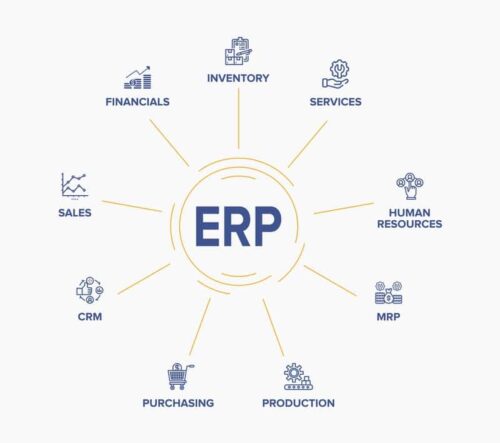
Back To Basics: What Is an ERP?
An ERP is business process management software that connects and integrates every aspect of a business — giving manufacturers visibility over their entire operation and allowing them to create better manufacturing processes, lower costs, and improve performance.

A manufacturing ERP that works as hard
as you do.
Give us a call to see how we’re different.

