In this guide, we’ll break down what manufacturing KPIs are, why they matter, how to choose the right ones for your business, and which KPIs are most commonly used by leading manufacturers today. We’ll also share real-world examples of how manufacturers are using KPIs to make smarter, faster decisions.
Manufacturers today have access to more data than ever before. But simply having data isn’t enough. The real challenge is knowing what to measure, and using that information to run a better, more efficient business.
Key Performance Indicators (KPIs) are critical for manufacturers that want to improve efficiency, reduce costs, and stay competitive. But it’s not always easy to know which KPIs to focus on. Many manufacturers end up tracking too many numbers, or focusing on metrics that only tell them what happened after it’s too late to make changes.
What Are Manufacturing KPIs and Why Do They Matter?
A Key Performance Indicator (KPI) is a measurable value that shows how effectively a company is achieving key business objectives. In manufacturing, KPIs help you understand how your operations are performing and where you can improve.
All KPIs are metrics, but not all metrics are KPIs. KPIs are the select few measurements that directly tie into your business goals and help you make critical decisions. Instead of tracking every possible number, KPIs focus your attention on what really matters to your success.
What Should Be on Manufacturing Leaders’ Radar in 2026
Why Manufacturers Need to Measure KPIs
Quick Answer: What are the most important KPIs for manufacturers?
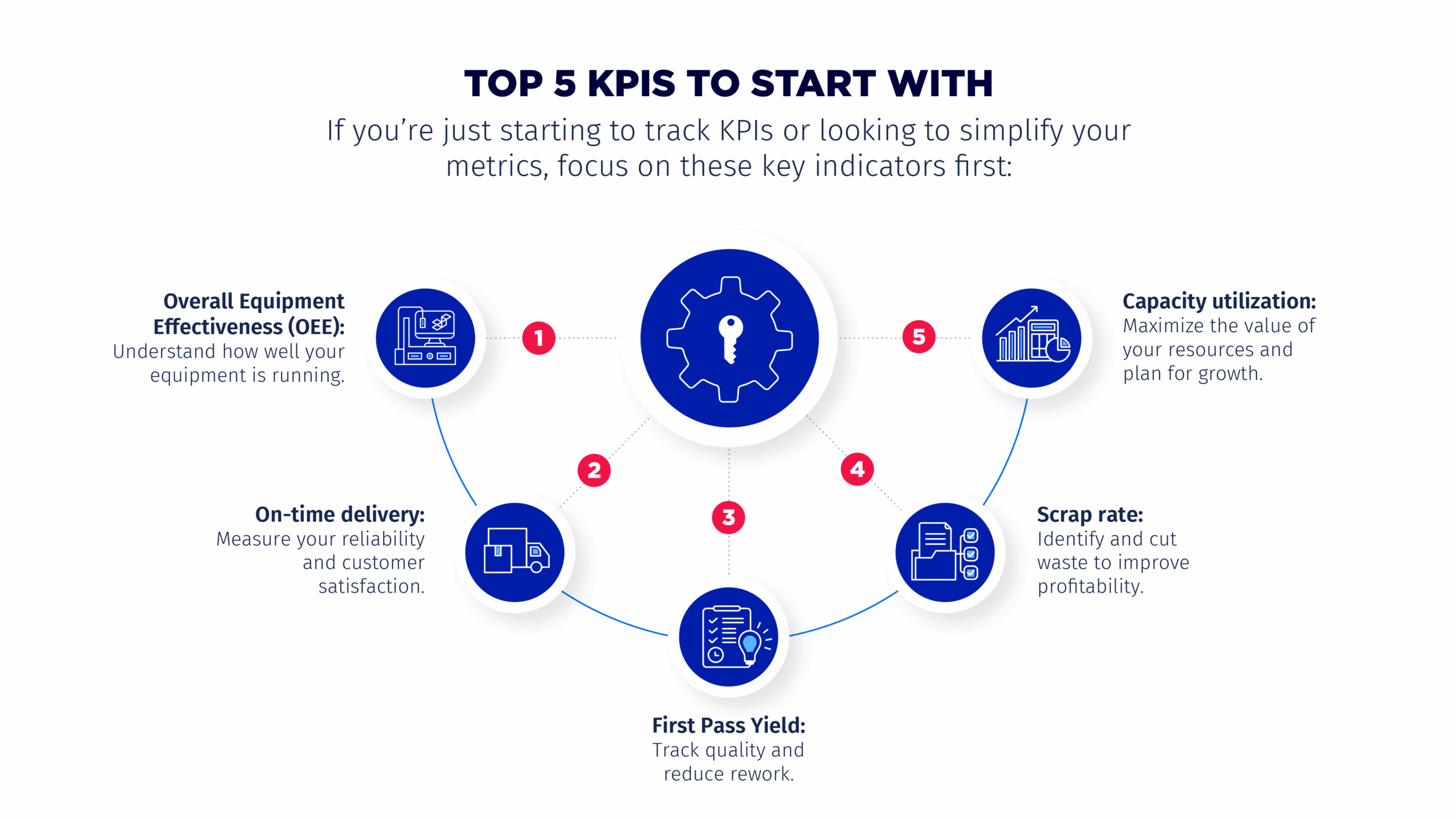
- Overall Equipment Effectiveness (OEE)
- On-time delivery
- First Pass Yield
- Scrap rate
- Capacity utilization
These core KPIs help you understand quality, efficiency, and customer delivery performance — and provide a strong starting point for most manufacturing businesses.
KPIs help manufacturers improve nearly every part of their operations — from increasing throughput and reducing scrap to improving on-time delivery rates and keeping costs in check.
But there’s an important difference between KPIs that tell you what has already happened and KPIs that help you act in real time.
As Kaleb James, Managing Director of Stafford Engineering, explains, “Most businesses track KPIs that exist in the past — the ‘what has happened’ — not ‘what is currently happening.’” By focusing only on historical data, manufacturers miss opportunities to correct course and improve outcomes.
At G.M. Precision, real-time data helped uncover hidden inefficiencies on the shop floor. President and CEO Mathieu Robert shared how monitoring live machine data allowed them to validate true production times, adjust schedules, and provide more accurate updates to customers.
The bottom line: KPIs shouldn’t just describe your past performance — they should help you steer your business forward.
How to Choose the Right Manufacturing KPIs for Your Business
There isn’t a single list of KPIs that every manufacturer should track. Your KPIs should align with your business goals, growth stage, and specific challenges.
Start by asking:
- What are our most important business objectives right now?
- Where are our biggest risks or bottlenecks?
- What decisions do we need better visibility on?
For example, if you’re growing quickly, liquidity and cash flow metrics might be critical. If quality is a top priority, you might focus more on yield and defect rates.
As Mathieu Robert puts it, “Start with simple indicators that make sense to you — and then improve your KPIs over time.”
It’s also essential to think about where your data comes from and ensure you have systems in place (like an ERP or BI tool) that can pull accurate, real-time information from multiple sources.
How to Make KPIs Actionable
Measuring KPIs is important, but simply tracking numbers isn’t enough — you need to turn those insights into action. The goal of KPIs is to guide decision-making and drive continuous improvement across your business.
Here’s how to make your KPIs truly actionable:
- Tie KPIs to specific goals: Every KPI should connect to a business objective, like reducing lead time, improving quality, or increasing profitability. This makes it clear why you’re tracking each metric and what you want to achieve.
- Share them with the right people: KPIs should be visible to the teams who can act on them — not just management. Shop floor displays, real-time dashboards, and regular team meetings help ensure everyone stays aligned and knows what’s important.
- Set thresholds and alerts: Define acceptable ranges for each KPI and set up alerts for when metrics move outside of those ranges. This helps you catch issues early, before they become bigger problems.
- Review regularly and adjust: Hold routine reviews to discuss KPI trends, identify root causes behind performance gaps, and create action plans. As your business evolves, update your KPIs to stay aligned with new priorities.
- Focus on continuous improvement: Use KPIs as a tool to encourage small, ongoing improvements rather than just as a scorecard. When teams see progress and understand the impact of their efforts, they’re more motivated to keep pushing forward.
By making your KPIs actionable, you transform them from static reports into powerful tools that help you improve performance and achieve your business goals.
Tracking and acting on KPIs is only possible if you have access to accurate, up-to-date data — and that’s where an ERP system comes in.
An ERP (Enterprise Resource Planning) system acts as a single source of truth for your business. It integrates your core operations — from the shop floor to finance and sales — and captures data in real time. This gives you complete visibility into your performance and makes it much easier to track your key performance indicators and act on them confidently.
Here’s how an ERP system supports KPI measurement:
- Centralized data: ERP systems bring together information from all parts of your business in one place. Instead of relying on disconnected spreadsheets or manual reports, you get a single, reliable view of your operations.
- Real-time insights: Modern ERPs deliver up-to-the-minute data so you always know what’s happening now, not just what happened last month. This enables faster, more informed decision-making.
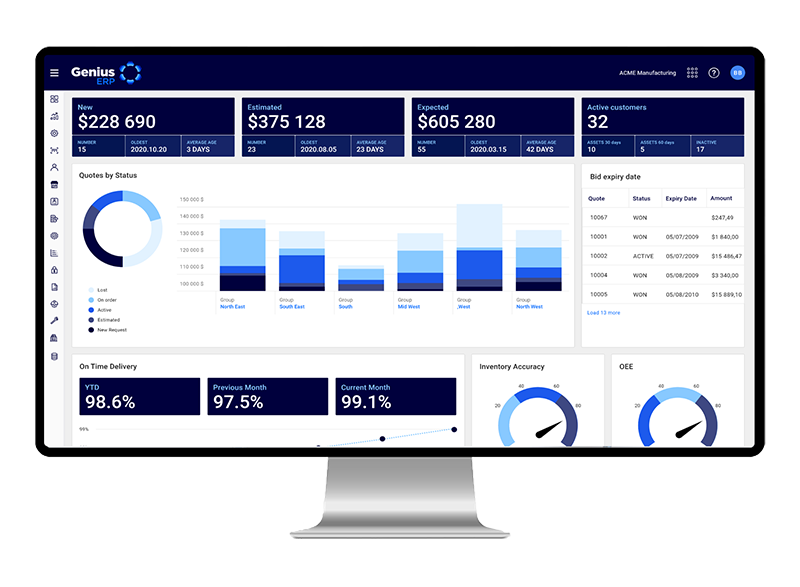
- Automated dashboards: ERP dashboards make KPIs visual and easy to monitor at a glance. You can customize them for each department to focus on what matters most.
- Improved accuracy: Automated data collection reduces manual entry and errors, ensuring your KPIs are based on dependable information.
- Support for continuous improvement: With real-time, accurate KPIs, you can spot trends, track improvements, and adjust processes to meet your goals.
Why Choose a Manufacturing-specific ERP?
Not all ERP systems are created equal. While a generic ERP might offer broad functionality, a manufacturing-specific ERP is designed to address the unique challenges that manufacturers face every day.
A manufacturing-focused ERP comes with built-in tools and dashboards tailored for production, inventory, scheduling, engineering, and more. This means you get out-of-the-box KPIs that matter to your business — no heavy customization required.
Even more importantly, by working with an ERP partner that understands manufacturing, you gain more than software — you gain expertise. A specialized partner helps you define meaningful KPIs, tailor dashboards to your goals, and support you as you grow and evolve.
With the right partner, your ERP becomes the foundation for smarter decisions, stronger performance, and lasting success.
Top Manufacturing KPIs to Consider
While your KPIs should be tailored to your business, here are some of the most common — and most valuable — manufacturing KPIs to consider:
- Overall Equipment Effectiveness (OEE): Combines availability, performance, and quality into one measure to show how effectively your equipment is being used. Tracking OEE helps identify the biggest sources of lost productivity and guides improvements to maximize uptime and output.
- On-time delivery: Measures the percentage of orders delivered to customers on or before the promised date. This KPI is critical for maintaining customer satisfaction, building trust, and avoiding costly penalties or lost business due to late shipments.
- Throughput: The total amount of product produced over a given period. Monitoring throughput helps you understand how efficiently your operations are running and whether you can meet current and future demand.
- Yield (First Pass Yield): The percentage of products manufactured correctly the first time without rework. A high first pass yield means better quality control, lower costs from scrap and rework, and faster production cycles.
- Scrap rate: Tracks the percentage of defective products that cannot be reworked and must be scrapped. By monitoring scrap rates, you can identify quality issues early, reduce material waste, and improve overall profitability.
- Capacity utilization: Measures how much of your total production capacity is being used. Higher capacity utilization means you’re making the most of your equipment and resources, while lower rates can signal underused assets or opportunities for growth.
- Cycle time: The time it takes to produce one unit from start to finish. Shorter cycle times improve responsiveness to customer orders, reduce inventory holding costs, and increase overall throughput.
- Changeover time: The time required to switch a machine or line from producing one product to another. Reducing changeover times boosts flexibility, enables smaller batch sizes, and helps you respond more quickly to changing customer demands.
- Inventory turns: The number of times inventory is sold and replaced during a given period. Higher inventory turnover indicates efficient inventory management, reduces holding costs, and frees up cash flow.
- Customer return rate: The percentage of products returned by customers. Keeping this number low reflects strong product quality and high customer satisfaction, while a rising return rate can signal issues that need immediate attention.
- Gross margin (overall and by product): Measures profitability after direct production costs are subtracted from revenue. Tracking gross margin helps you evaluate product performance, control costs, and make more informed pricing and production decisions.
- Sales growth: Tracks revenue growth over time. Monitoring sales growth helps you evaluate the effectiveness of your sales strategies, identify market opportunities, and support planning for future investments.
- Quote-to-close ratio: Measures the percentage of sales quotes that successfully convert into orders. A higher ratio indicates a more efficient and effective sales process, helping you understand how well your team is performing and where improvements are needed.
- Lead time: The time from receiving a customer order to delivering the finished product. Shorter lead times improve customer satisfaction, support just-in-time manufacturing, and can give you a competitive edge in the market.
Net profit vs. fixed assets: Compares net profit to investments in fixed assets (like machinery and equipment). This KPI helps assess how efficiently your assets are generating profit and supports smarter capital investment decisions.
How Real-Time Business Intelligence Helps
Manufacturers Make Better Decisions
Real-world Example: Helping Manufacturers Choose the Right KPIs
We worked with one manufacturer going through a period of rapid growth. As their production and sales volumes increased, they faced new risks, such as tighter cash flow, overhead creep, potential quality issues, and margin pressures.
To help them navigate this, we worked together to define the right KPIs for each department, such as:
- Production: Capacity utilization, machine downtime, gross margin by product, on-time delivery, and reject rates.
- Engineering: Estimation accuracy, schedule variance, product development cycle time, and scope variance.
- Sales: Sales growth, customer churn rate, quote-to-close ratio, and customer lifetime value.
- Finance/Admin: Cash flow metrics, acid test ratios, AR and AP turnover, and net profit versus fixed assets.
Rather than tracking everything, we focused on the KPIs most relevant to their risks and goals — like a dashboard warning light for their business. We also helped them build dynamic dashboards to make these KPIs easy to access and act on in real time, reducing human error and improving responsiveness.
Other examples of how we have helped manufacturers use real-time KPIs to boost performance include Stafford Engineering and G.M. Precision. At Stafford, they installed screens throughout their shop floor to show live KPIs and keep the team aligned. At G.M. Precision, real-time machine data has helped them improve efficiency and provide more accurate updates to customers. Both companies started simple and evolved their KPIs over time to match their changing needs.
Why You Need to Work with a Manufacturing-focused Partner
Choosing the right KPIs isn’t just about picking numbers from a list; it’s about deeply understanding your business, your risks, and your goals. That’s why working with a partner like Genius ERP makes such a difference.
As a manufacturing-specific ERP built by experts who understand the industry, Genius ERP gives you the tools, dashboards, and guidance to define and measure the KPIs that matter most. Beyond just software, you get a long-term partner who helps you continually improve, adapt, and grow stronger.
With Genius ERP, you’re not just implementing a system — you’re building a foundation for smarter decision-making and lasting success.

Conclusion
Choosing and tracking the right KPIs is one of the most important steps manufacturers can take to improve efficiency, stay competitive, and grow sustainably.
Rather than overwhelming yourself with too many numbers, focus on a few key metrics that align with your business strategy and provide actionable insights. Start simple, and evolve as your business and goals change.
With the right ERP and BI tools, you can build dynamic dashboards that turn your data into real-time insights — helping you move from analyzing the past to steering your business forward.
Curious about which KPIs can help your manufacturing business work smarter and grow stronger? Let’s talk.
"*" indicates required fields