Choosing between ERP and CRM does not need to be complicated. We explain the role of each system, how they differ and why many manufacturers benefit from ERP software with integrated CRM functionality.
ERP and CRM: Which Does Your Manufacturing Business Need?
ERP and CRM systems help businesses manage information, connect teams and work more efficiently, but they are designed for different purposes.
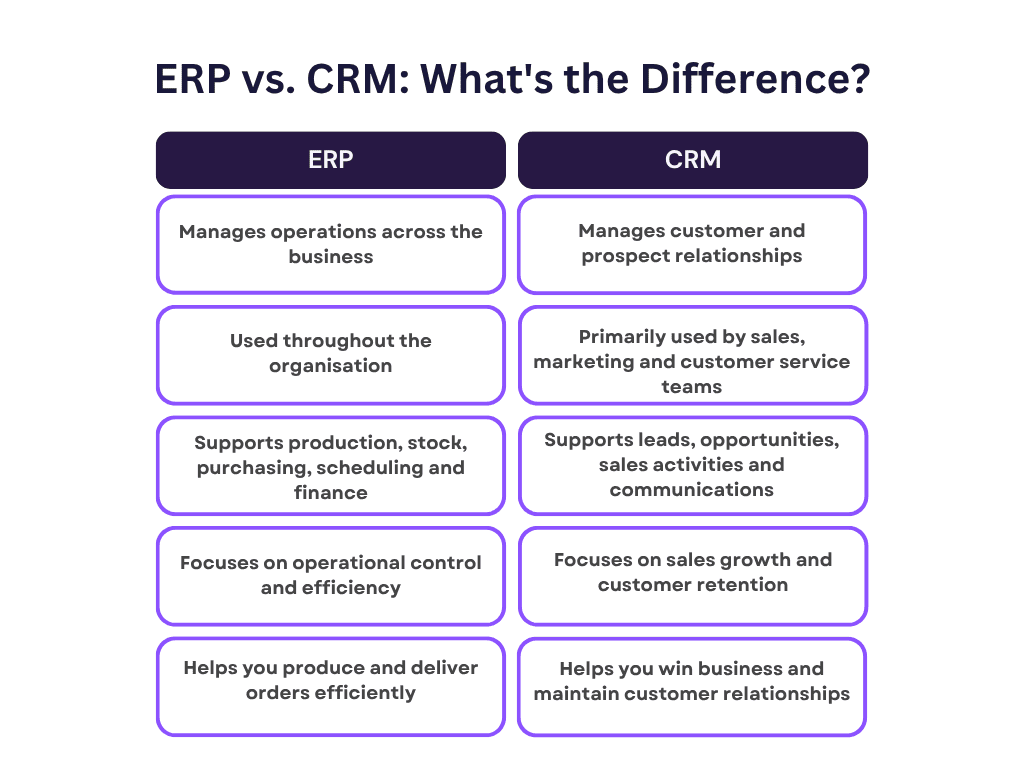
A Customer Relationship Management (CRM) system helps you manage prospects, customers and sales opportunities. An Enterprise Resource Planning (ERP) system connects and manages processes across your organisation, including production, stock, purchasing, scheduling and finance.
For manufacturers, the decision is not necessarily about choosing one system over the other. It is about understanding what each one does and how they can work together to connect your sales activities with the rest of your operations.
How CRM Helps Manufacturers Manage Sales
A CRM (Customer Relationship Management) system helps businesses manage their relationships with prospective and existing customers, from the first enquiry through to sales and ongoing support.
It gives your sales team a central place to organise contact details, communications, leads, opportunities and follow-up activities. With a clearer view of each account and opportunity, salespeople can stay on top of conversations, respond at the right time and develop stronger customer relationships.
This is particularly useful in manufacturing, where sales cycles can be long and technically complex. Your team may be working on several opportunities at once, each involving different decision-makers, engineering input and multiple versions of a quotation. A CRM keeps these details connected so opportunities continue to move forward and important information is not lost in emails, spreadsheets or individual notes.
A CRM can help manufacturers:
- Manage prospect and customer records
- Track leads and sales opportunities
- Plan follow-ups and sales activities
- Keep a complete history of customer communications
- Monitor and manage the sales pipeline
- Improve customer service and response times
- Report on opportunities and sales performance
By giving your sales team a complete view of each relationship, a CRM can help them communicate more effectively, manage longer sales cycles and turn more opportunities into orders.
Genius CRM
How ERP Helps Manufacturers Run Their Operations
While CRM software concentrates on sales and customer relationships, ERP (Enterprise Resource Planning) software manages the processes required to run the wider business.
As a manufacturing company grows, it becomes increasingly difficult to manage its operations using separate spreadsheets, accounting packages and manual processes. An ERP system brings areas such as production, stock, purchasing, engineering, scheduling, project management and finance together, allowing teams to share accurate, up-to-date information.
For manufacturers, an ERP can help:
- Plan and schedule production
- Manage stock and purchasing
- Monitor job costs and profitability
- Improve manufacturing efficiency
- Streamline accounting and financial processes
- Standardise processes across the business
- Support reporting and informed decision-making
Because everyone has access to the same information, employees spend less time looking for answers, reconciling different records or correcting avoidable mistakes.
In simple terms:
- CRM helps you win the work.
- ERP helps you deliver the work.
Together, they connect sales with the rest of your operations.
Do Manufacturers Need ERP, CRM or Both?
Many manufacturers benefit from having both because each system supports a different part of the organisation. CRM software helps sales teams manage prospects, opportunities and customer relationships, while ERP software connects the operational processes required to plan, produce and deliver customer orders.
A CRM helps sales teams stay organised, manage their pipeline and respond to customers. An ERP helps manufacturers plan resources, control costs and complete work efficiently and profitably.
ERP and CRM: Which Does What?
- Use a CRM to: Manage prospects, leads, opportunities and customer relationships.
- Use an ERP to: Manage production, stock, purchasing, scheduling and financials.
- Use both together to: Connect sales and operations, allowing information to move from the first customer enquiry through production, delivery and ongoing support.
What Manufacturers Should Look for in a CRM
General-purpose CRM software does not always reflect the way manufacturers sell. When comparing systems, look for functionality that can support complex sales processes and connect effectively with the rest of your manufacturing operations.
Contact Management
Keep customer, prospect and key contact details in one place, together with their communication history, quotations and previous orders.
Lead and Opportunity Management
Follow potential business from the first enquiry through quotation and order. Clear opportunity records help sales teams prioritise their time and follow up when it matters.
Sales Pipeline Management
See where each opportunity sits in the sales process. A visible pipeline makes it easier to forecast potential business, review progress and identify opportunities that have stalled.
Tasks and Activity Tracking
Schedule meetings, assign follow-ups, set reminders and keep track of outstanding actions so customer enquiries are handled consistently.
Reporting and Dashboards
Use current sales and pipeline information to monitor performance, recognise trends and make better-informed decisions.
Customer Service Management
Record customer questions, service requests and follow-up activities alongside other account information. This gives employees the context they need to respond promptly and maintain a complete history of the customer relationship.
Why Manufacturers Benefit from Integrated ERP and CRM
Some manufacturers use separate ERP and CRM systems. Although this approach can work, it may also leave information divided between two databases and create additional administrative work. Customer details, quotation information or order requirements may need to be entered more than once, increasing the chance of discrepancies and delays.
ERP software with integrated CRM functionality brings customer and operational information together in a single system. Sales, engineering, production, purchasing and finance can work with the same up-to-date information rather than relying on manual updates between departments.
An integrated system can help your business:
- Reduce repeated data entry
- Improve communication between teams
- Minimise errors caused by missing or outdated information
- Answer customer questions more quickly
- Produce more accurate quotations
- Follow an order throughout its lifecycle
- Understand customer history and profitability
This connection is especially valuable for manufacturers of complex, configured or engineer-to-order products. Sales may need input from engineering to prepare a realistic quotation, while purchasing and production require accurate specifications once the order is confirmed. An integrated system allows the information gathered during the sales process to support the work that follows.
It also gives managers a more complete picture of the business. Instead of viewing sales, production and financial results separately, they can see the full relationship between an opportunity, the resulting order, the cost of completing it and its profitability. This helps them identify problems, understand future demand and make decisions using information from across the organisation.
nvoicing and repeat business. This visibility makes it easier to identify bottlenecks, forecast demand and deliver a more consistent customer experience.

How ERP and CRM Connect Sales and Operations
An integrated ERP and CRM connects the stages between the first customer conversation and the completed order. Information captured by sales can support engineering, purchasing, production, despatch, finance and customer service without being recreated at every handover.
When systems are disconnected, employees may have to copy details from one application to another as work moves through the business. This takes time and creates opportunities for important requirements to be missed or entered incorrectly. Integration reduces these manual transfers and makes relevant information available to the departments that need it.
Lead → Opportunity → Quotation → Sales Order → Engineering → Purchasing → Production → Despatch → Invoice → Ongoing Customer Relationship
As a lead develops into an order, the information becomes useful to more areas of the business. Sales records the customer’s requirements and prepares the quotation. Engineering confirms technical details where required. Purchasing sources the necessary materials, production plans and completes the work, and finance manages invoicing.
Because the information remains connected throughout the process, teams have greater visibility of the order and its requirements. This improves collaboration, reduces unnecessary administration and makes it easier to give customers accurate updates.
How ERP Improves the Customer Experience
Customers may never know which ERP system you use, but they notice the results of the processes it supports. They know whether quotations are accurate, questions are answered promptly, commitments are reliable and orders arrive when expected.
ERP helps create this consistency by giving employees better information and connecting the departments involved in fulfilling an order. Stronger internal processes make it easier to provide dependable service, resolve issues and build customer relationships that lead to repeat business.
Choosing the Right Solution
The choice between ERP and CRM is not about deciding which type of software is better. The right starting point depends on the problems your business most needs to solve.
If you need to improve sales organisation, gain greater control of your pipeline and manage customer relationships more consistently, a CRM may be the immediate priority.
If you need better visibility and control across production, stock, purchasing, scheduling and finance, an ERP is likely to deliver more value.
For most manufacturers, however, these needs overlap. ERP with integrated CRM functionality connects opportunities and customer information with the operational processes used to fulfil orders. It reduces manual administration and gives teams visibility from the initial enquiry through quotation, production and delivery.
Conclusion: Connecting Sales with the Rest of Your Business
CRM and ERP software serve different but complementary purposes. A CRM helps your business manage prospects, opportunities and customer relationships. An ERP helps you plan production, control operations and deliver work efficiently.
When these capabilities are connected, information can move more easily from sales into the rest of the organisation. This gives manufacturers a clearer view of each customer and order, reduces unnecessary manual work and supports a more consistent experience for employees and customers alike.
—-
Want to learn more about what CRM software can do for your manufacturing business? Explore the top 5 benefits of a CRM for manufacturers or discover Genius CRM, a fully integrated CRM built for manufacturers that sell complex products.
"*" indicates required fields