Article

Best ERP for Manufacturing 2025

Custom Manufacturing, ERP, Industry News - All industries

Choosing the right ERP is one of the most important decisions a manufacturer will make. 

Finding the best ERP for manufacturing in 2025 is about more than just picking software from a list—it’s about selecting a system that fits your processes, solves today’s challenges, and sets you up for tomorrow. The right ERP can mean the difference between hitting deadlines, managing costs, and keeping customers happy, or falling behind competitors that have already modernized their operations.

At Genius ERP, we work only with manufacturers, so we know what it takes to get it right. Choosing the best software is about finding the best fit for you, including the best fit for your culture, your business needs and goals, your manufacturing type and more. 

In 2025 you also have to look at the roadmap for each software you are considering. Are they investing in improving the product or are they standing still with outdated technology? Are they developing AI features and keeping up with industry trends? Are they building more of what you need as a manufacturer, or expanding into other industries that mean nothing to your growth?

In this article, we break down what manufacturers should look for in an ERP partner in 2025, including why industry expertise and strong implementation support matter. We’ll compare generalist ERPs like SAP and Dynamics with manufacturing-specific systems like Genius ERP and ProShop, and highlight the top trends shaping the ERP landscape this year from AI tools to real-time shop floor tracking. 

You’ll also see how different ERPs fit specific types of manufacturing, from engineer-to-order to process manufacturing, and read customer stories that show how manufacturers are using ERP to cut lead times, improve delivery rates, and grow their businesses.

Choosing the Right ERP Partner in 2025

Picking the best manufacturing ERP isn’t just about features on paper—it’s about finding a partner that knows your industry.

Importance of Industry Expertise, Training, and Support

A system that looks good in a demo can quickly become a headache if your ERP vendor doesn’t understand how manufacturers really work. In 2025, manufacturers should be asking: 

  • Does this ERP specialize in manufacturing? Generalist ERPs like SAP or Dynamics can do almost anything, but for a small-to-mid-sized manufacturer they often mean extra overhead, customization, and cost. When ERP software is built around the realities of the shop floor, manufacturers cut wasted steps and realize value much sooner.
  • What does implementation look like? ERP success comes down to training, adoption, and support. Ask about success rates, timelines, and customer satisfaction—not just features.
  • Will the ERP scale with you? You don’t want to outgrow your ERP in a few years. Look for platforms that can support your current needs while handling future growth.
Generalist vs. Specialist ERPs

Which is Right for You?

One of the biggest choices in 2025 is whether to go with a generalist ERP (SAP, Microsoft Dynamics, Infor, Oracle) or a specialist ERP (Genius ERP, ProShop, JobBOSS², BatchMaster).

Specialist ERPs are purpose-built. Manufacturing ERPs offer features designed with the shop floor in mind, and tend to be faster to implement and cost less. For example, Genius ERP, built by manufacturers, supports a wide range of shops—from ETO and MTO to job shops and beyond. ProShop ERP is tailored for aerospace job shops, while BatchMaster focuses on process manufacturing.

Generic ERPS are powerful. They’re built to support every type of business operation—not just manufacturing—across multiple industries and global markets. Large enterprises often need that level of flexibility. The tradeoff is higher cost, added complexity, and longer implementation. SAP S/4HANA, for example, excels at coordinating supply chains across continents, but most mid-sized shops don’t need—or want—that kind of overhead.

How to decide?

If you’re an enterprise manufacturer with thousands of employees, a generalist like SAP or Infor might make sense.

If you’re a small-to-mid-sized manufacturer, a manufacturing-specific ERP usually delivers more value because it fits your processes out of the box. 

If you’re ready to dive deeper into what makes a manufacturing-specific ERP different, check out our Beginner’s Guide to Manufacturing ERPs


The 2025 ERP Landscape for Manufacturers

The ERP market keeps shifting, but three big themes stand out this year.

Emerging Trends: AI, IoT, and Real-Time Data

In 2025, the best ERP systems for manufacturing are evolving into even more powerful tools for managing and improving operations.

They’re integrating:

  • AI tools for smarter scheduling, quoting, and document automation.
  • IoT connectivity to track machines, tools, and shop-floor performance in real time.
  • Live dashboards that give managers visibility across production, inventory, and supply chain.

These features help cut wasted steps, reduce downtime, and let manufacturers make faster, better decisions.

Challenges Manufacturers Face in Today’s Environment

Even with great technology, manufacturers still face real-world challenges, like:

  • Supply chain complexity: Unpredictable shipping times, suppliers, and rising costs.
  • Labor shortages: Hiring challenges are pushing manufacturers to maximize output with the teams they have.
  • Pressure on margins: Customers expect faster delivery and higher quality, but not higher prices.

The best ERP software for manufacturing addresses these challenges head-on by streamlining processes and giving you the tools to work smarter and get more done.

ERP Recommendations by Manufacturing Type

Choosing the best ERP for manufacturing depends on what kind of manufacturer you are. Each production model comes with unique challenges, and different ERPs have built strengths in different areas.

Engineer-to-Order (ETO)

The Challenge:
ETO manufacturers design from scratch after the order comes in. Every project is complex and unique, which makes accurate quoting, BOM creation, and scheduling difficult. A small mistake in engineering can cascade into cost overruns and late deliveries.

How ERPs Help:
An ERP designed for ETO ties engineering and production together. CAD integrations automatically generate BOMs, while project costing and scheduling tools keep projects on track. Without this, manufacturers often end up with siloed systems that don’t talk to each other.

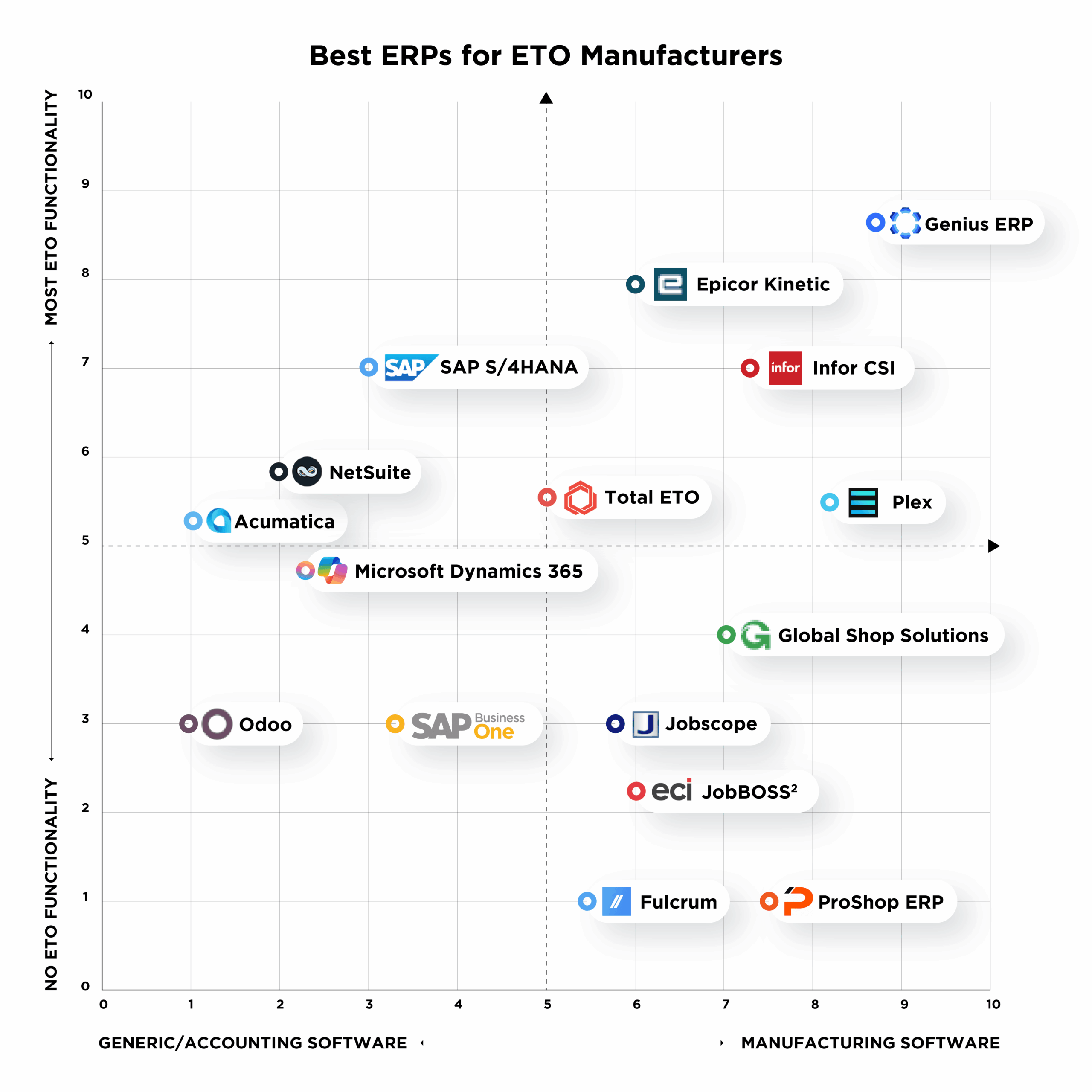
Graphic chart ranking ERP systems for engineer-to-order (ETO) manufacturers based on ETO functionality and whether they are generic or manufacturing-focused software.

Best ERPs for Engineer-to-Order Manufacturers:

  • Genius ERP – Built for custom and ETO manufacturers, Genius ERP is strongest when jobs are complex. CAD2BOM ties engineering to production in one step, sending accurate BOMs and routings straight to the floor. Project costing, scheduling, and job tracking give leaders a clear view of margins. With cloud or on-premise options and implementation led by manufacturing engineers, it’s designed for the realities of ETO.
  • Global Shop Solutions – A solid choice for small to mid-sized shops, especially those operating in mixed ETO/MTO environments. Global Shop is known for shop-floor control and scheduling, keeping production moving day-to-day. The all-in-one setup and simple interface make it approachable, though it doesn’t go as deep with ETO-specific engineering tools.
  • Epicor Kinetic – A versatile system with broad functionality across industries. Its product configurator helps manufacturers with customizable products, and it supports both discrete and project-based work. Implementation can be complex, but it scales well and has a wide partner network—better suited to larger ETO organizations.
  • Infor CloudSuite Industrial (SyteLine) – Known for its configurability, Infor CSI offers strong planning, supply chain, and analytics features, making it appealing for bigger or multi-site companies. Smaller shops may find it heavy, since it often needs customization to fully fit their processes.
  • Acumatica – A modern cloud ERP with solid BOM management and cost tracking. Its licensing model—based on resources instead of users—can be attractive to growing companies. While it’s not ETO-specific, it integrates well with third-party tools and delivers a clean, user-friendly experience.
  • Total ETO – A niche solution for smaller ETO businesses. It covers project basics like job costing, estimating, and purchasing in a straightforward way. It doesn’t have the depth of bigger ERPs, but it’s simple, affordable, and a good step for shops starting to digitize.

Configure-to-Order (CTO)

The Challenge:
CTO manufacturers let customers choose from a set of options, but managing all those product variations can get messy. Quoting mistakes or incorrect configurations can lead to rework, delays, and unhappy customers.

How ERPs Help:
The best ERPs for CTO have configurators tied directly to quoting and engineering. This ensures every order is accurate, properly costed, and ready for the shop floor.

Best ERPs for Configure-to-Order Manufacturers:

  • Epicor Kinetic – Best known for its product configurator, Epicor handles complex rules and dependencies well, automatically creating BOMs, routings, and costs. It’s a strong fit for manufacturers with highly customizable products. The flexibility is powerful, but it usually takes careful setup and ongoing management to get the most out of it. 
  • Genius ERP – A strong middle ground for shops balancing ETO and CTO work, Genius supports both engineered and configured products in one system. CAD2BOM and a native Product Configurator tie engineering and quoting together, while project management tools help teams respond quickly to customer needs. It’s especially effective for high-mix, low-volume shops that juggle both workflows.
  • Infor CloudSuite Industrial (SyteLine) – With advanced quoting and configuration features, Infor CSI works well for manufacturers running both CTO and MTO operations at scale. Integrated supply chain and planning tools support multi-site companies, giving mature organizations better visibility and control. Smaller shops may find it heavy, since it often requires resources to fully manage.
  • Acumatica – Built as a modern, cloud-first ERP, Acumatica integrates well with outside configurator tools while supporting BOMs, pricing, and quoting. Its licensing model appeals to growing mid-sized companies, and the open platform makes it easy to tailor. Out of the box, its configurator isn’t as advanced as Epicor’s, but the flexibility is there.
  • Global Shop Solutions – Global Shop delivers solid functionality for CTO manufacturers, with quoting, BOM management, and shop-floor tools. It is particularly appealing for smaller manufacturers that want an all-in-one ERP without too much complexity. Configurator options are limited compared to larger ERPs, but it covers the basics well for simpler CTO needs.
  • Plex Smart Manufacturing Platform – A cloud-native system built for modern manufacturers, Plex is strong in shop-floor integration and traceability. It’s a good fit for CTO companies in regulated industries like aerospace or automotive. While it excels in production management, configurator depth doesn’t match Epicor or Infor, making it a better choice in hybrid environments.

Assemble-to-Order (ATO)

The Challenge:
ATO shops rely on subassemblies that are stocked in advance, then finished to customer specs. The balancing act is stocking enough subassemblies without tying up too much capital, while also delivering final products on time.

How ERPs Help:
An ERP connects scheduling and inventory so manufacturers can see exactly what’s in stock, what’s needed, and when products can be assembled. This prevents both shortages and overstock.

Best ERPs for Assemble-to-Order Manufacturers:

  • Epicor Kinetic – Advanced configuration and inventory management tools make Epicor a strong choice for complex ATO operations. It can automatically generate BOMs and routings based on order-driven assemblies, streamlining the process. Implementation is often resource-heavy, but for companies scaling up, the configurator depth can deliver real value.
  • Genius ERP – Well-suited for ATO manufacturers in mixed-mode environments, Genius connects sales, engineering, and production in one system. Strong planning, scheduling, and inventory control ensure subassemblies are ready without tying up cash in excess stock. It’s a practical fit for high-mix shops that need to assemble quickly while keeping a close eye on costs.
  • Infor CloudSuite Industrial (SyteLine) – Infor CSI brings deep planning and scheduling capabilities that help ATO manufacturers manage component availability and delivery timelines. Integrated supply chain and production modules support multi-site operations and fast turnaround. It’s a system that tends to fit larger organizations with the resources to handle its complexity.
  • Acumatica – Cloud-first and flexible, Acumatica supports ATO workflows with solid inventory, BOM, and costing features. Its licensing model can be attractive for growing manufacturers who want scalability without steep per-user costs. While its configurator isn’t as advanced as Epicor’s, the platform adapts well with integrations and custom setups.
  • Plex Smart Manufacturing Platform – With strong real-time shop-floor data and traceability, Plex is a good match for ATO manufacturers in regulated industries like aerospace, electronics, or automotive. The cloud-native platform supports digital manufacturing and compliance needs, though advanced configurator functions may require third-party tools.

  • SAP Business One (SAP B1) – Though not always top-of-mind for ATO, SAP B1 can work well for small to mid-sized companies. Integrated modules for inventory, purchasing, planning, and sales help keep subassemblies on hand and final assemblies moving. It’s not as specialized as some ERPs but offers a solid, all-around option.

Make-to-Order (MTO / Job Shops)

The Challenge:
Job shops and MTO manufacturers handle low-volume, high-mix work. Every order is different, deadlines are short, and quoting or scheduling errors can wipe out profit. Manual systems usually can’t keep up with the pace.

How ERPs Help:
The best ERPs for MTO provide accurate quoting, job costing, and live shop-floor visibility. This keeps jobs moving, margins healthy, and delivery dates realistic.

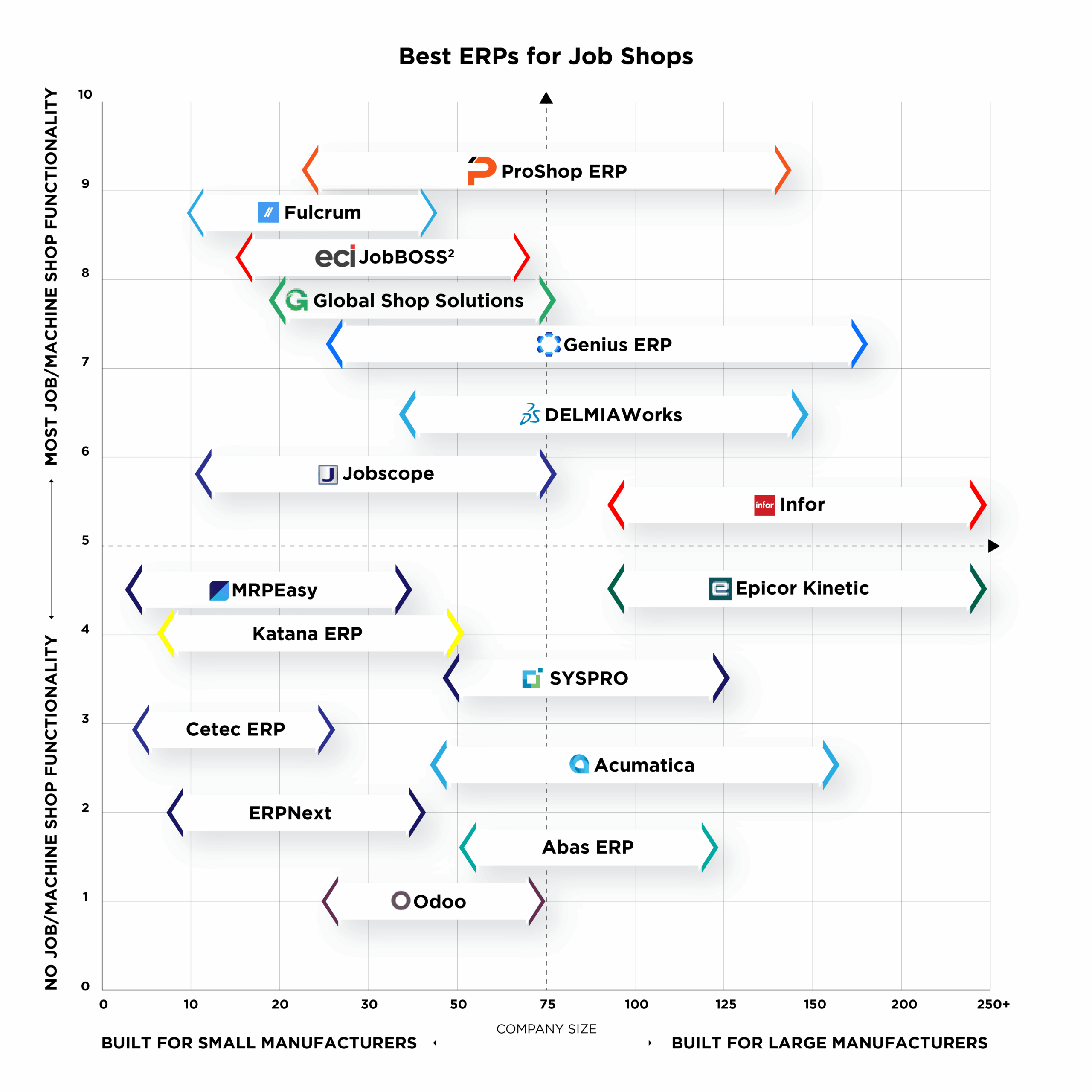
Ranking of ERPs for job-shop operations, showing which systems perform best for manufacturers of different sizes (small to large).

Best ERPs for Job Shop Manufacturers:

  • ProShop ERP – Built for precision job shops and regulated industries like aerospace, defense, and medical, ProShop is cloud-first and geared toward paperless workflows. Its biggest strength is tight quality and compliance integration—traceability, audits, and documentation are baked in. The detail it demands can mean a bigger upfront investment, and shops need to commit to disciplined processes to get the full benefit.
  • JobBOSS² (ECI Software) – A longtime player in the job shop space, JobBOSS² offers quoting, job tracking, and scheduling in a familiar format many shops already know. Its history means a lot of operators are comfortable with its workflows. That said, it’s less nimble with complex configurations, and connecting it to newer technologies often requires add-ons or middleware.
  • Fulcrum –  Marketed as a “shop OS,” Fulcrum is a newer cloud-native option designed to replace legacy shop systems. It emphasizes live job tracking, real-time cost capture, and easy-to-use operator interfaces. Its flexibility on the floor is a plus, though gaps remain in advanced areas like QMS and scheduling for more automated environments.
  • Genius ERP –  While often associated with more engineered or custom manufacturing, Genius also fits job shops that want stronger integration across quoting, BOMs, scheduling, and execution. The unified workflow reduces silos, helping shops move from bid to delivery without disconnects. Some shop-floor modules may need customization or partner add-ons, but the system covers core job shop needs well.
  • Jobscope ERP –  Well-suited to project- and order-driven shops, Jobscope includes quoting, job costing, shop-floor control, materials planning, and financials under one license. The all-inclusive model keeps cost structures straightforward. On the downside, setup can be complex given the breadth of features, and documentation is sometimes noted as thin.

Make-to-Stock (MTS)

The Challenge:
MTS shops produce goods in advance based on forecasts. The risks are tying up cash in excess inventory or losing sales when forecasts miss. Managing this balance at scale requires real-time data and strong forecasting tools.

How ERPs Help:
ERPs built for MTS integrate demand forecasting, supply chain planning, and inventory management in one place. This helps manufacturers reduce stockouts and avoid overproduction.

Best ERPs for Make-to-Stock Manufacturers:

  • SAP S/4HANA – Best suited to large enterprises, SAP S/4HANA brings deep supply chain orchestration and production planning together on one platform. It handles real-time inventory across global operations and integrates procurement, warehousing, and manufacturing. Advanced forecasting and analytics make it ideal for high-volume MTS organizations, though its cost and complexity put it out of reach for most smaller manufacturers.
  • Epicor Kinetic – A strong fit for mid-sized MTS manufacturers, Epicor combines production planning, scheduling, and inventory management in one system. It supports batch production and demand-driven replenishment, helping companies balance efficiency with responsiveness. The system scales well, but implementation and upkeep can require significant resources.
  • NetSuite – As a cloud-first ERP, NetSuite unifies financials, order management, and inventory control. It gives clear visibility into stock levels, safety stock, and reorder points, making it practical for manufacturers wanting tighter back-office and production alignment. Manufacturing tools aren’t as deep as specialized ERPs, but the modern cloud platform appeals to growing companies.
  • Katana MRP – Designed for small manufacturers, Katana provides real-time inventory tracking, multilevel BOMs, and simple production planning in an easy-to-use interface. E-commerce and accounting integrations make it a good fit for MTS companies selling direct-to-consumer. It doesn’t offer the depth of bigger systems, but it’s a cost-effective first step toward ERP.
  • Odoo – With its modular approach, Odoo covers inventory, sales, and manufacturing workflows at an affordable entry point. It includes basic scheduling, BOM management, and capacity planning, with the flexibility to add more as needed. Its open-source model makes it highly adaptable, though out-of-the-box features don’t match the depth of larger ERPs—best for smaller, simpler operations.

Repetitive / Flow

The Challenge:
High-volume, standardized production runs mean uptime and efficiency are critical. If a line goes down or output slows, costs skyrocket.

How ERPs Help:
Repetitive-friendly ERPs provide scheduling, throughput tracking, and capacity planning to keep lines running smoothly and prevent costly downtime.

Best ERPs for Repetitive Manufacturers:

  • SAP S/4HANA – A top choice for enterprise manufacturers, SAP S/4HANA handles complex flow production with supply chain, execution, and quality all tied together. Advanced planning tools and real-time analytics help optimize operations across multiple plants. The system is extremely powerful, but its scale and rollout costs make it realistic only for large enterprises with the resources to manage it.
  • Infor LN – Well-suited to large and complex industries like automotive and aerospace, Infor LN supports high-volume repetitive production and global supply chains. It offers deep scheduling, materials planning, and compliance features, making it a strong fit for mature organizations. Smaller flow manufacturers may find the system more than they need.
  • Epicor Kinetic – A good mid-market option, Epicor combines scheduling, lean manufacturing tools, and shop-floor monitoring. Its flexibility makes it useful for manufacturers blending repetitive processes with discrete or mixed-mode work. It doesn’t reach enterprise scale like SAP or Infor, but it delivers robust functionality without the same level of implementation burden.
  • Plex Smart Manufacturing Platform – As a cloud-native ERP/MES, Plex emphasizes real-time shop-floor data and connectivity. It works especially well for high-volume and automotive manufacturers that need to monitor quality and production metrics continuously. The modern, scalable design is a plus, though advanced planning often requires outside integrations.
  • IQMS (Dassault Systèmes DELMIAWorks) – Popular in plastics, automotive, and electronics, IQMS combines ERP and MES for repetitive manufacturing. It covers production scheduling, quality management, and traceability with strong ties to shop-floor execution. Best results come when companies align closely with its target industries, where its strengths are most effective.

Process Manufacturing (Continuous / Batch)

The Challenge:
Process manufacturers deal with recipes, compliance, and traceability. A single mistake in formulation or labeling can lead to recalls, regulatory issues, and wasted product.

How ERPs Help:
The best process ERPs include formula management, lot tracking, compliance documentation, and batch control — all critical for regulated industries like food, chemicals, and pharmaceuticals.

Best ERPs for Process Manufacturers:

  • BatchMaster ERP – Strong in recipe-driven production, BatchMaster covers formulation, batch processing, compliance, and traceability in depth. It’s widely used in chemicals, nutraceuticals, and food and beverage, where process controls are critical. Not built for discrete work, but for fully process-driven companies it’s one of the most capable ERPs available.
  • Aptean Process Manufacturing ERP – Aptean offers prebuilt templates for food, beverage, chemicals, and pharmaceuticals, helping manufacturers implement faster with industry-specific functionality. Allergen tracking, hazardous materials handling, and strict quality controls make it a trusted tool for regulated industries. Its focus is narrow, but the depth in those sectors is hard to match.
  • Deacom ERP – Designed for mid-market process manufacturers, Deacom unifies formula management, quality, compliance, and production in a single system. The “all-in-one” model reduces reliance on bolt-ons, keeping operations under one platform. It works best for companies willing to adapt to Deacom’s standardized workflows rather than customize heavily.
  • Infor CloudSuite Process (M3) – Infor’s M3 platform targets process manufacturers at an enterprise scale, particularly in chemicals, food, and beverage. It brings strong global supply chain, production planning, and compliance capabilities, backed by advanced analytics. Powerful and scalable, though resource-intensive to implement, making it most suitable for larger organizations.
  • JustFood ERP – Focused specifically on food and beverage, JustFood ties recipe management, food safety, quality checks, and recall management together. It’s a strong fit for small and mid-sized manufacturers in the F&B sector. While its scope is narrower than broader ERPs, the specialization adds real value in its target market.

Top Features of Genius ERP in 2025

While generalists try to be all things to all industries, Genius ERP focuses only on manufacturing. That’s why it stands out in 2025 as one of the best ERP systems for manufacturing.

schema blue background texture
Related Reading

ERP Solutions for Manufacturers

Real-Time Shop Floor Tracking

Genius ERP connects your office and shop floor in real time:

  • Live dashboards show progress, bottlenecks, and machine use
  • QR-code scanning tracks inventory with near-perfect accuracy
  • Managers see exactly where every job stands—no chasing updates

Other key features include:

Customer Success Stories & Case Studies

The real test of an ERP isn’t a feature list—it’s what manufacturers achieve with it. Here are a few stories from shops using Genius ERP:

  • Marathon Equipment: Marathon used Genius ERP to cut through the bottlenecks holding them back. With better scheduling and shop-floor management, they not only reduced lead times by half but also positioned themselves to grow revenue by 20%. The system gave their team the tools to deliver faster, without sacrificing quality.

  • Jennison Manufacturing: Jennison turned to Genius ERP to bring order to a busy, high-mix shop floor. Smarter scheduling tools helped them align capacity with demand, leading to a 30% reduction in late orders. With jobs moving more smoothly through the shop, they’ve been able to boost both on-time delivery rates and customer satisfaction.

  • Machitech Automation: By connecting their engineering, inventory, and production processes with Genius ERP, Machitech was able to scale up their operations smoothly. What once slowed them down — manual updates and disconnected systems — is now streamlined, giving their team the visibility and control they need to keep growing and serving more customers.

ERP ROI FAQs

What is the best ERP for manufacturing in 2025?

It depends on your business type and size. ETO and custom shops often see the most value with Genius ERP, while large enterprises or process manufacturers may be better suited to SAP, Epicor, or BatchMaster.

Why does industry expertise matter when choosing ERP?

Because you don’t have time to train your vendor on how your shop works. An ERP built for manufacturing comes with the processes, tools, and best practices you need already baked in.

Which ERP works best for small and mid-sized manufacturers?

Specialist ERPs like Genius ERP, ProShop, or JobBOSS² are usually a better fit. Generalist systems like SAP or Dynamics are powerful, but they’re often too complex and expensive for SMBs.

Final Thoughts

Finding the best ERP for manufacturing in 2025 isn’t about following a “top 10” list—it’s about matching your business type with the right ERP partner. Generalist ERPs may dominate the headlines, but for most small-to-mid-sized manufacturers, the best results come from specialist ERPs built for the shop floor.


If you’re ready to explore what a manufacturing-specific ERP could do for you, start with Genius ERP.

"*" indicates required fields

This field is for validation purposes and should be left unchanged.
close-btn

Let’s talk about your shop

We’ll get back to you within one business day.
No spam, just a real conversation.

"*" indicates required fields

This field is for validation purposes and should be left unchanged.
This site is protected by reCAPTCHA and the Google Privacy Policy and Terms of Service apply.